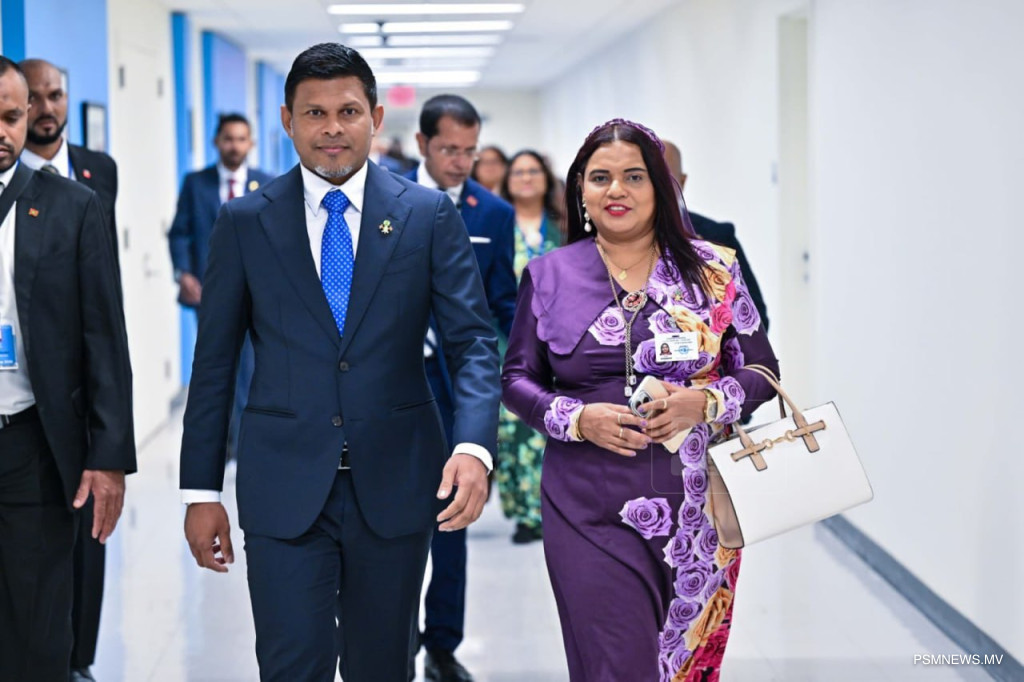
Vice President Urges Global Climate Finance Reform to Meet 2040 Development Goal
Addressing the 81st session of the United Nations General Assembly, Vice President Hussain Mohamed Latheef linked the Maldives' ambition to become a developed nation by 2040 to the urgent need for reformed climate finance and stronger international support for Small Island Developing States (SIDS).
The Vice President detailed President Dr. Mohamed Muizzu's vision for the country, which focuses on raising productivity, diversifying the economy, and investing in resilient infrastructure and renewable energy. However, he warned that these national goals are contingent upon an international financial system that empowers rather than restricts small states.
Vice President Latheef emphasized that for island nations, rising sea levels are no longer just environmental concerns but critical matters of national security. He argued that the current financial architecture often fails to account for the unique challenges faced by SIDS, such as geographic isolation and extreme vulnerability to external shocks.
To bridge this gap, the Vice President called for climate finance to be predictable, accessible, and delivered with a higher reliance on grants and highly concessional funding. He specifically advocated for the implementation of the Sevilla Commitment and highlighted the Borrowers’ Platform as a vital mechanism for giving developing nations a stronger voice in global financial decision-making.
Central to this strategy is President Muizzu’s “Maldives First” policy. The Vice President explained that this approach seeks partnerships based on mutual respect and national interest, ensuring that international cooperation strengthens domestic capacity without creating new forms of debt-driven dependence.
Looking ahead to COP31 in Antalya, the Vice President urged the international community to move toward a "COP of delivery," where success is measured by tangible implementation rather than vague commitments. He asserted that global promises only hold value when they enable actual progress on the ground.
Ultimately, the Vice President framed the 2040 ambition as a pursuit of both development and sovereignty. He concluded that for the Maldives to determine its own future, the global community must provide the financial space and policy flexibility necessary for vulnerable states to invest in long-term resilience.