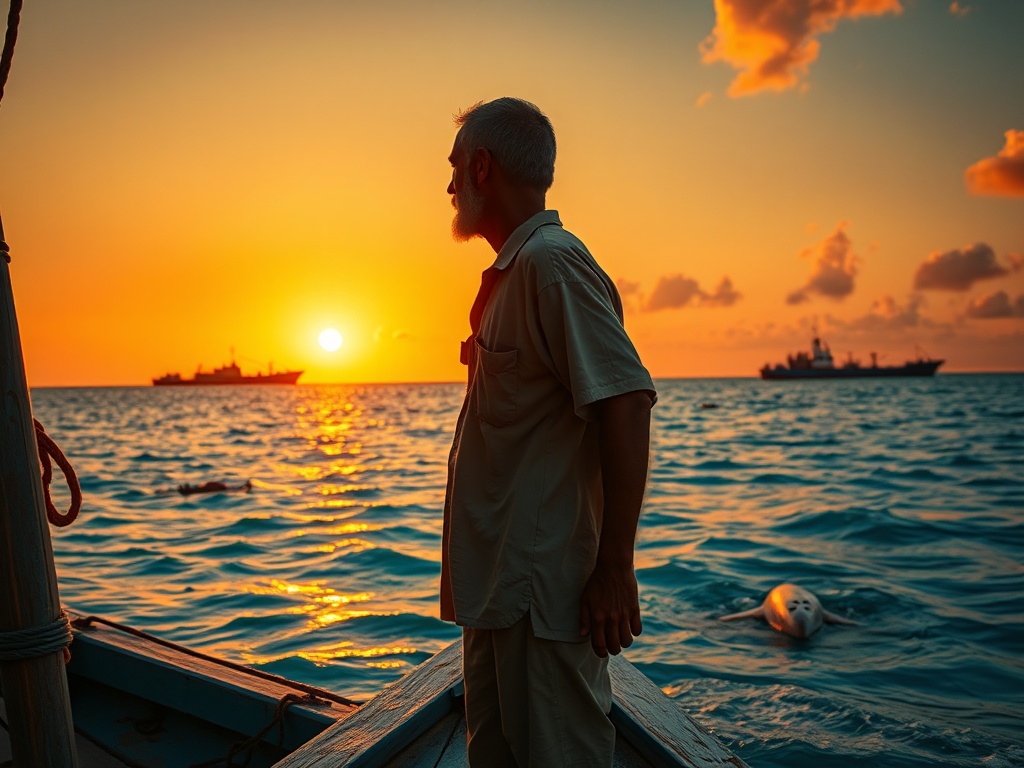
Waves of Betrayal: A Fisherman's Fight for His Nation's Soul
The horizon bled orange as Ibrahim guided his dhoni back toward the atoll. The sea was his inheritance, the same waters his father and grandfather had fished. But today, the familiar rhythm of the waves felt different. He'd seen them again—foreign vessels, their industrial silhouettes stark against the dying sun, operating with impunity just beyond what should have been protected waters.
"They don't recognize our shore," he muttered to the empty boat, the words swallowed by the ocean's breath. He remembered the sharks—not the graceful creatures he'd grown up respecting, but the mutilated remains he'd found drifting. Fins sliced off, bodies discarded like garbage. The fishermen knew this brutality, witnessed it in silence while politicians in Malé debated land allocations and election strategies.
Back on his home island, the air was thick with different tensions. At the local coffee shop, men argued about housing policies, their voices rising like the evening tide. "Most who get land are already well-off," one man insisted, stirring his sweet tea. "Multi-storey houses, inherited property—and now they want more?"
Ibrahim listened, his hands still smelling of salt and diesel. He thought of his own family's cramped living situation, the endless wait for housing that never came. The government's promises felt like mirages—visible but untouchable, vanishing when you got too close.
He remembered his brief, bewildering arrest during the MDP regime. No charges, no explanation—just two days in a cell that smelled of damp concrete and regret. "I did nothing illegal," he'd told the officers, but justice, like the monsoon winds, seemed to blow in only one direction.
As night settled over the atoll, Ibrahim stood on the beach, watching the bioluminescent plankton glow in the shallows. The sea had its own justice, its own memory. It remembered the sharks, the foreign vessels, the generations of fishermen who understood its rhythms. The land disputes, the political maneuvering—these felt temporary against the eternal pulse of the ocean.
He thought about freedom—what it meant to be a man without strings in a nation tangled in them. The foreign military presence, the land grabs disguised as policy, the corruption that seeped into everything like saltwater into wood. Yet in the darkness, the stars reflected perfectly on the calm sea, each one a promise that some things remained untouchable by politics.
The real threat wasn't just the foreign vessels cutting fins beyond the 200-mile limit. It was the slow erosion of something deeper—the connection between people, their land, and their sea. And Ibrahim knew, as his father had known, that while governments changed and policies failed, the ocean would always remember who truly belonged to these islands.
— Source fragments: Foreign vessels industrial scale shark finning, fishermen know this brutality; Free from government affiliations, man without strings; Housing policies benefiting already wealthy, inherited property disputes; Personal arrest experiences and questioning justice; Foreign military base concerns; Political parties scared of losing votes