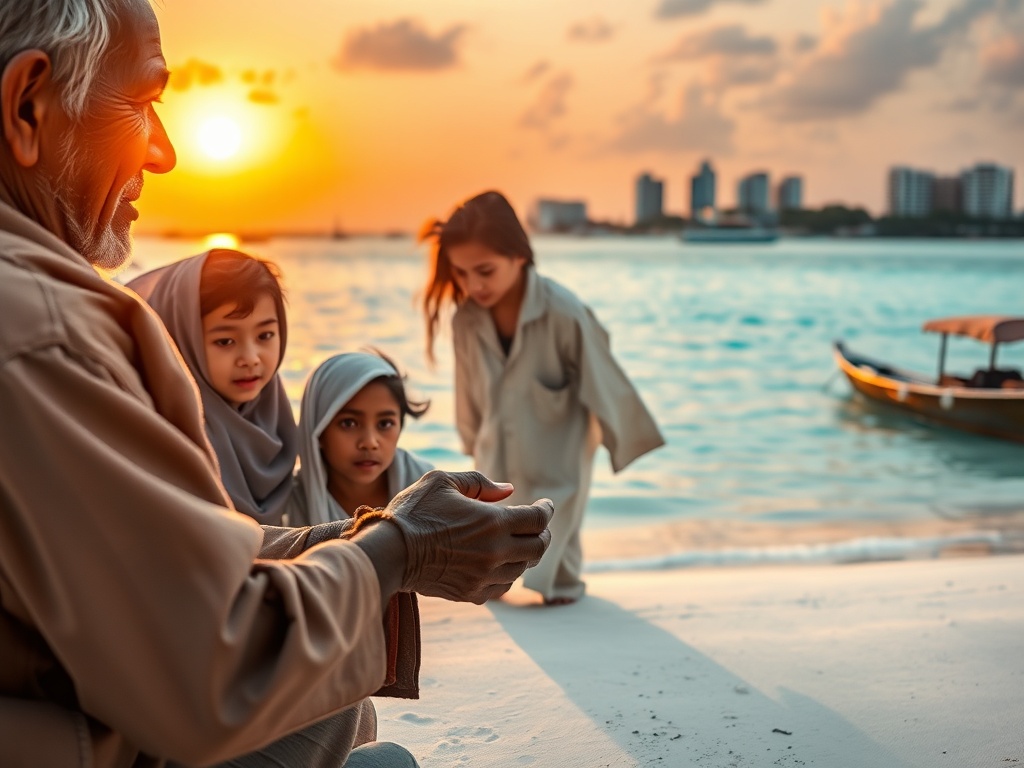
What Does It Mean to Be Dhivehin Today?
The question echoes through Maldivian social spaces, through family gatherings and coffee shop conversations: What does it mean to be Dhivehin today? The answer grows more complex with each passing year, as layers of history, religion, and modern influence create competing narratives of identity.
There's a growing awareness that something essential is slipping away. Older generations remember traditions now spoken of with amusement or disbelief—rituals that once defined community life. The stories of temple ceremonies and ancient practices feel increasingly distant, like artifacts from another civilization. Yet this distance creates its own discomfort, as people wonder what has been lost in the transition to modernity.
Today's children navigate a different cultural landscape entirely. Bombarded by foreign media and competing narratives, many young Maldivians develop confused notions of their origins. The persistent idea that Dhivehin came from neighboring countries rather than evolving as a distinct island civilization speaks to deeper issues in how history is taught and cultural identity is formed. When a child cannot distinguish between ancient Maldivian heritage and foreign cultural imports, something fundamental has broken in the transmission of identity.
Recent government efforts to address this through cultural ministries represent recognition of the problem. But institutional solutions struggle against powerful currents of globalization, political division, and decades of cultural drift. The challenge isn't merely preserving artifacts or documenting traditions—it's helping new generations understand why these things matter.
The tension between past and present manifests in subtle ways. Families who once practiced ancient rituals now follow different traditions, yet the underlying human need for meaning and belonging remains constant. The forms change, but the questions persist: Who are we? Where did we come from? What holds us together as a people?
As Maldivians navigate these questions, they're building a new relationship with their heritage—one that acknowledges complexity rather than seeking simple answers. The work isn't about returning to some idealized past, but about creating a future where Maldivian identity can evolve without being erased. It requires confronting difficult truths about what has been lost while recognizing what endures—the resilience of island communities, the adaptability that has always characterized Dhivehin culture, and the quiet determination to preserve what matters most.
In the space between ancient temples and modern ministries, between ancestral practices and contemporary life, Maldivians are writing the next chapter of their story. The pen moves uncertainly at times, but the hand that holds it remains unmistakably Dhivehin.
— Source fragments: We joke about the absurd beliefs of our forefathers; kids are convinced we dhivehin came from India and Lanka; they have no idea we were an ancient people with ancient culture; creation of Gaumiyyathu Ministry; their mandate is important; we have raised a couple of generations who think we are refugees