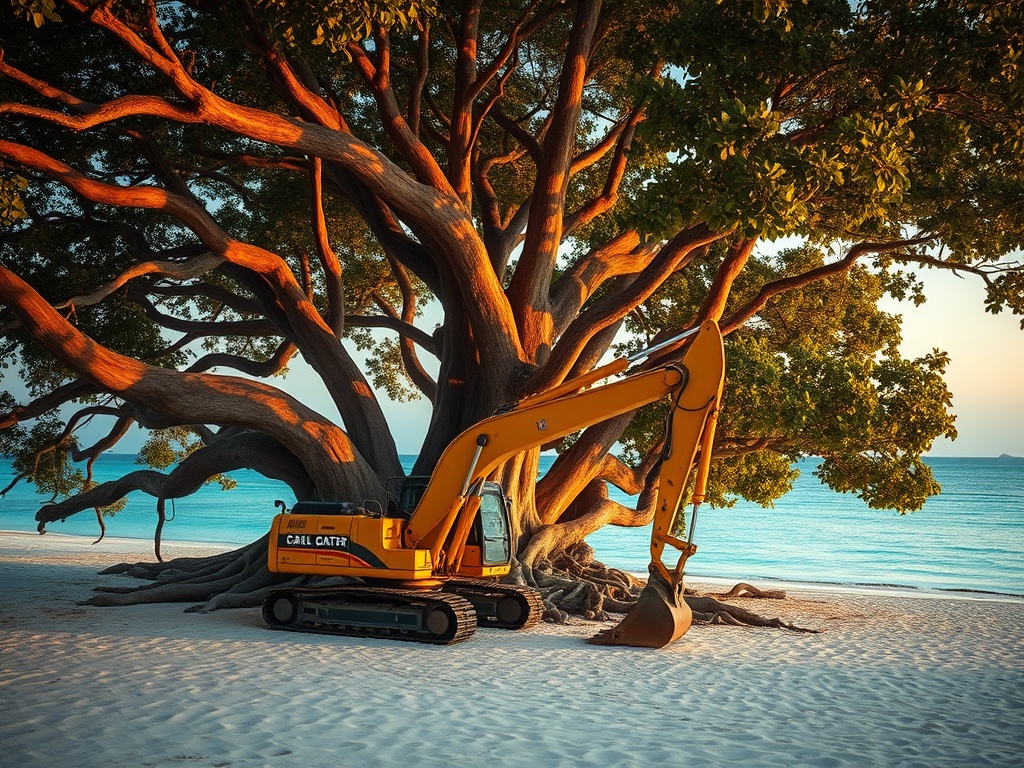
What We Lose When Banyan Trees Make Way for Concrete
Across the scattered islands of the Maldives, a quiet erosion is underway—not just of shorelines, but of the natural barriers that have protected these communities for generations. The debate has shifted from whether development should occur to what kind of protection we're willing to sacrifice for it.
Critics argue that policy makers in this fragile geographic setting fail to recognize how natural defenses function as our first line of protection. The big trees that have stood for nearly a century, the coastal vegetation that anchors the soil, the mangroves that absorb storm surges, and the reefs that break wave energy—these aren't merely scenic features. They are living infrastructure, developed over centuries, that protect us from natural disasters. Their removal creates vulnerability that cannot be easily replaced by technological alternatives.
The conversation has taken an ironic turn with claims about environmental sustainability. While some projects promote battery-operated vehicles for transporting materials, observers note this represents merely a surface-level approach to ecological responsibility. The fundamental issue remains the extraction and exploitation inherent in current development models. The contradiction lies in celebrating minor green initiatives while ignoring the larger environmental costs of removing natural protections.
This tension reflects a broader philosophical conflict about development itself. The current approach appears rooted in systems that prioritize rapid construction over long-term sustainability. Environmental advocates point out that this model inherently conflicts with genuine ecological preservation, creating a paradox where projects marketed as progress actually undermine the very systems that keep island communities safe.
As weather patterns grow more unpredictable, questions arise about what constitutes normal geological phenomena versus precursors to larger catastrophes. The removal of natural barriers coincides with increasingly severe weather events, raising concerns about whether we're witnessing the early stages of environmental feedback loops that could accelerate damage to coastal communities worldwide.
The most vulnerable regions—small island nations and low-lying coastal areas—face disproportionate risk. While the entire planet experiences climate disruption, the consequences manifest most immediately in places where natural protections have been compromised. The debate isn't merely about preserving scenery; it's about maintaining functional ecosystems that have protected human settlements for generations.
The central question remains whether we're replacing centuries-old natural guardians with inadequate technological substitutes. A ninety-year-old tree represents not just biomass but a complex living system that has weathered storms and stabilized land through multiple generations. Its replacement with temporary structures represents a fundamental shift in how we understand protection—from living, adapting systems to static, manufactured solutions.
This conversation transcends environmentalism to touch on deeper questions about what kind of society we're building. The tension between rapid development and sustainable preservation reflects competing visions of progress—one that sees nature as an obstacle to overcome, and another that recognizes it as the foundation upon which all human settlement depends.
— Source fragments: you cannot compare a 90yr old tree with 500 dhandi gandu and we know for a fact you will not take care of these to see it grow; Policy makers and decision makers in this fragile geographic setting fail to realise, the natural barriers we have like big trees, costal vegetation, mangroves, reefs, lagoons, all are in place to protect us frm natural disasters. By removing them, you are making us vulnerable; But but the plastic bottles are transported in a green fleet of battery operated vehicles; you have yet to realize the capitalism you so love and human rights you pretend to care with neolibrals is actually anti environment based extraction & exploitation; Are these geological/weather phenomenons normal? Or is this all leading to a bigger catastrophe? If so, what are the likely scenarios & what area/continent/countries are likely to be affected most?