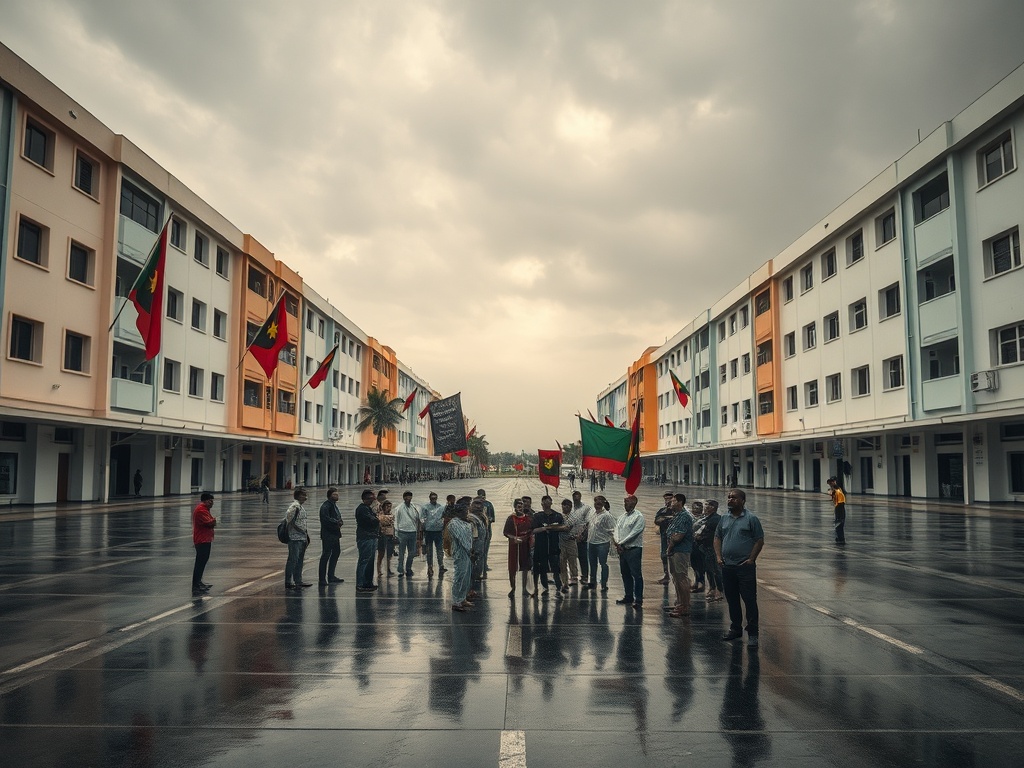
When 350 People Show Up, They Know They Can Ignore You
The numbers tell a sobering story. At recent protests, barely 350 people showed up—a figure meticulously counted by observers who note that when participation falls below critical mass, the authorities' response becomes more brazen. 'They do it because so few people go,' one analysis suggests, pointing to the mathematical reality of political resistance: without thousands in the streets, arrests carry little consequence.
This numerical decline reflects a deeper stagnation that has settled over Maldivian politics. Across party leaderships, a paralysis of imagination has taken root. The same arguments cycle endlessly through political discourse while genuine alternatives remain elusive. Party members themselves grow disinterested as recycled rhetoric fails to address the housing crises, economic pressures, and governance failures that define daily life for most Maldivians.
The opposition's current predicament stands in stark contrast to its revolutionary origins. The Maldivian Democratic Party, first recognized as a political reality in exile on November 10, 2003, emerged from a vision of democratic transformation. Today, that legacy feels distant as political movements struggle to recapture their founding integrity and purpose.
Public frustration manifests in multiple directions—toward the perceived arrogance of politicians elevated by excessive praise, toward foreign governments accused of interference, and toward the entire political class that seems to have forgotten its accountability to taxpayers. The 'Rayyithumeehaa' mentality—this cultural tendency to excessively praise leaders—is increasingly seen as poisonous, creating a political class disconnected from the people it serves.
Even protest etiquette reveals the tensions within the system. When authorities mistake peaceful conduct for appeasement, and when symbolic gestures like handshake refusals between officials make headlines, these become metaphors for deeper institutional fractures. Meanwhile, housing schemes prioritize political gain over genuine need, leaving thousands of registered citizens without solutions.
The challenge now is whether opposition movements can transcend internal divisions and rebuild the coalitions necessary to create meaningful pressure. Without renewed energy, strategic vision, and public trust, the political stalemate may continue indefinitely—a nation caught between discontent and the inability to channel it effectively toward change.
— Source fragments: They do it because so less people go. Even last protest barely 350 people. If say 2000 people show up, they can't arrest. And yes, I counted; Stagnation has set in… In the thoughts, minds, imaginations of party leaderships… Their own members are disinterested. The same nonsense being regurgitated over and over again; Dedicated to my father, Mohamed Latheef. Founder of MDP MDP was first recognized as a political reality on 10th November 2003, in exile; This mindset of Rayyithumeehaa poisons the minds of the politicians. Yes. The more you raise the politicians and praise them, the more arrogant and evil they become; Totally agree. We’ve been patient showing good conduct in our protests. Unfortunately, it seems the relevant Authorities have mistaken this for an Appeasement Policy on our part; Nasheed is still in a position of authority. He commands respect and therefore has more responsibility to fight for In his as Speaker of Majlis and a leader of , he pushed for the Binveriya scheme at the expense of thousands of RTs and dhaftharu people