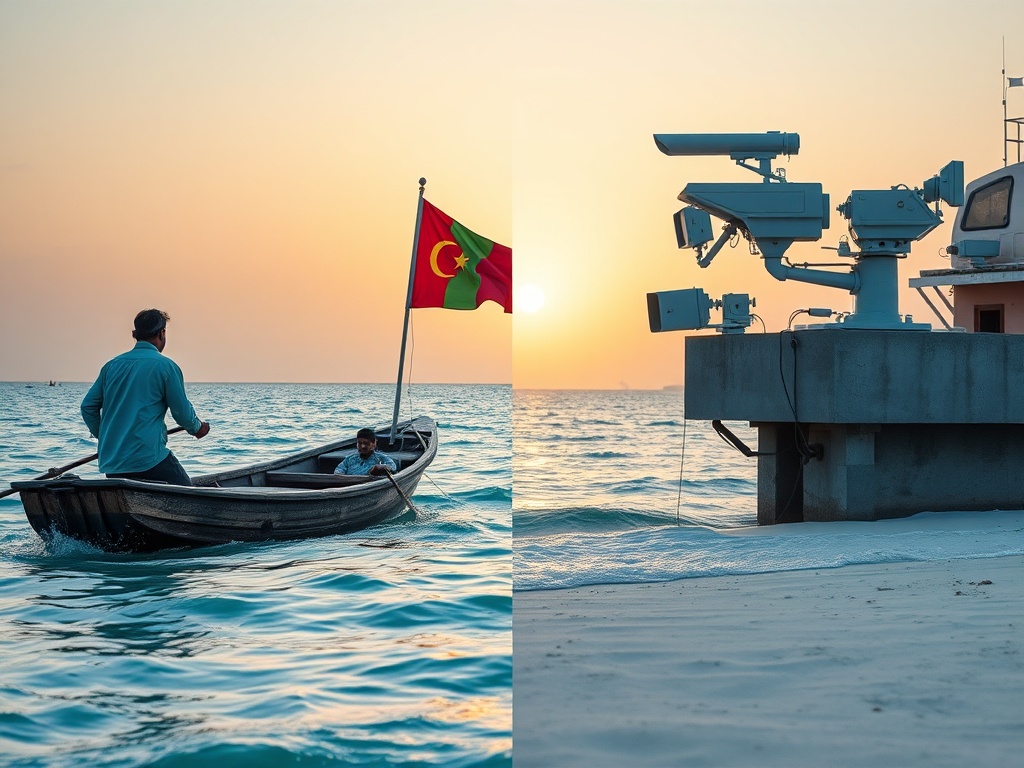
When Fishermen Share Waters With Foreign Warships
Across Maldivian social media and coffee shops, a fundamental question echoes through the national conversation: in an archipelago with no territorial disputes and no imminent invasion threat, what exactly are we defending against? The debate over military spending has moved beyond parliamentary chambers and into the public square, revealing deep divisions about national priorities in an era of complex geopolitics.
Critics point to the allocation of 4% of the annual budget to defense as fundamentally misplaced when islands lack basic services, education systems struggle, and healthcare remains inadequate. The argument centers on opportunity cost—every million-dollar drone purchased represents schools not built, hospitals not equipped, or housing projects not completed. This perspective questions the very premise of threat assessment, noting that the primary security challenges facing Maldivians—drug abuse, unemployment, and economic instability—require social investment, not military hardware.
Yet another strand of the discussion acknowledges the reality of foreign military presence in Maldivian territory. The recognition that Indian military assets operate within our exclusive economic zone has created a paradoxical situation where some argue for increased military spending precisely because foreign forces are already present. This viewpoint sees military investment as a necessary counterbalance, a way to assert sovereignty in waters where other nations already conduct surveillance and patrol operations.
The conversation grows more complex when considering the regional context. With multiple foreign powers maintaining presence in the Indian Ocean region, some voices warn against further militarization that could transform the Maldives from a neutral nation into a potential battleground. The memory of the British base that closed in 1976 contrasts with the current reality of multiple foreign military engagements in Maldivian territory, creating anxiety about sovereignty erosion.
What emerges from this public discourse is not merely a debate about budget percentages but a deeper conversation about national identity in a changing geopolitical landscape. The tension between the practical needs of Maldivian citizens and the abstract concepts of sovereignty and defense reflects a nation grappling with its place in a region where larger powers increasingly assert their influence. As the discussion continues, it reveals fundamental questions about what true security means for an island nation facing both internal challenges and external pressures.
— Source fragments: Traditional libraries debate, military spending percentages, foreign military presence concerns, sovereignty arguments, social spending priorities, regional power dynamics