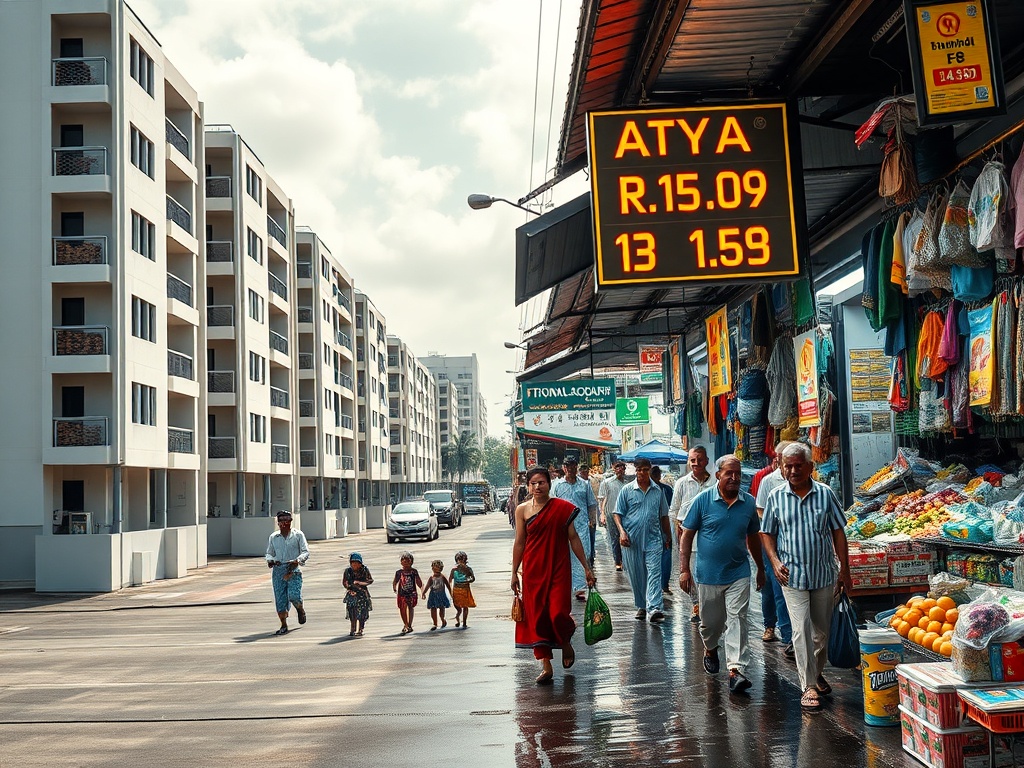
When Government Housing Stands Empty and Markets Run Out of Rufiyaa
In the quiet spaces between political rallies and official statements, a different conversation is unfolding across the Maldives—one about an economy increasingly divided between insiders and outsiders, between those who benefit from systemic privileges and those who bear its costs.
The frustration isn't about party colors or rally attendance numbers. It's about an economic reality where access to basic financial tools depends on who you know rather than what you contribute. At Bank of Maldives, employees access loans at 2.5% while ordinary citizens pay 11%. At housing developments like those managed by HDC and state-owned enterprises, flats materialize for connected individuals while others wait for years in housing limbo.
This privilege exists alongside sobering economic projections. With the dollar rate projected to reach 35 Rufiyaa by mid-2026, low-income families face mathematical impossibility in maintaining their standard of living. The very foundation of household economics threatens to collapse beneath them.
Meanwhile, the government's approach to economic development faces scrutiny. Rather than leveraging strategic investments like submarine cables to attract diverse investors through incentivized models, policies seem to favor quick fixes that leave Maldivians holding "worthless scrap metal" instead of sustainable assets.
The core contradiction remains stark: while tourism and fisheries generate nearly all national income, the workers in these sectors see minimal benefit from the system they sustain. The disconnect between economic contribution and reward has never been more apparent.
Economic observers note a troubling pattern emerging—one where government salaries and benefits flow disproportionately to certain sectors while creating what many fear will be a society of "many multi-millionaires" alongside "thousands in extreme poverty." The middle ground, once the bedrock of Maldivian society, appears to be vanishing.
The debate has shifted from political theater to fundamental questions of economic justice. How did a nation blessed with natural wealth and strategic positioning arrive at a place where policy becomes privilege? Why do those who power the economy find themselves locked out of its benefits?
As the currency crisis looms and the cost of living soars, these questions are no longer academic. They're becoming the daily reality for families trying to navigate an economic landscape where the rules seem written for someone else's benefit.
— Source fragments: Economic privilege in banking and housing; currency crisis projections; missed development opportunities; disconnect between economic contributors and beneficiaries