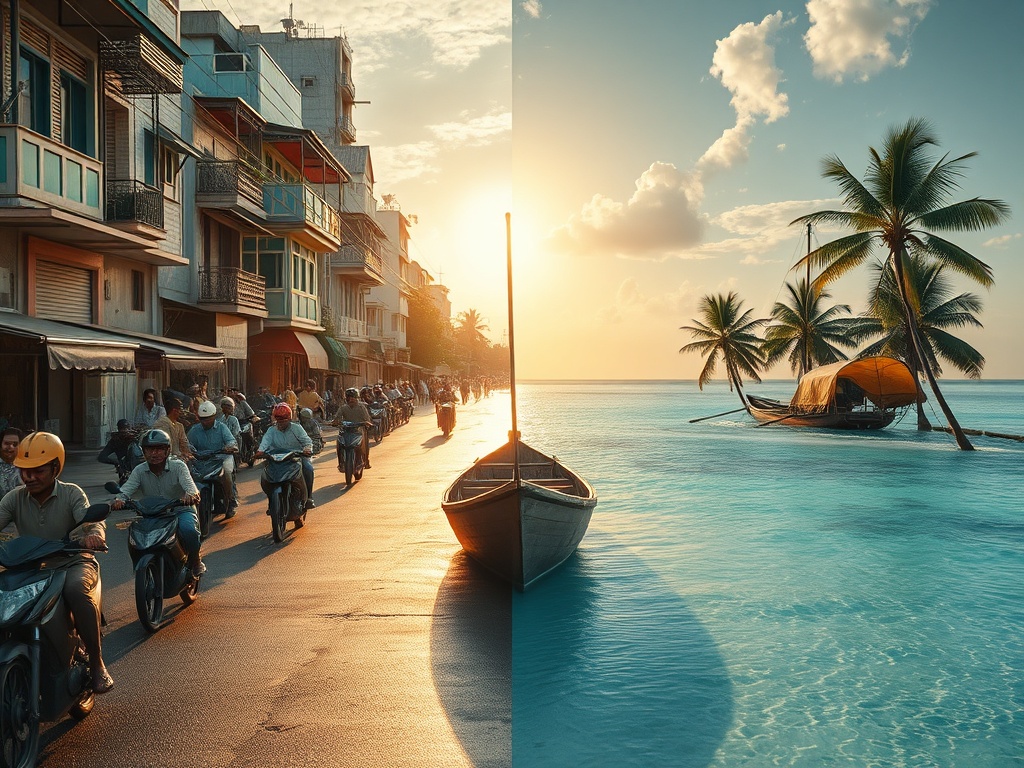
When GST Rises in Malé, Who Pays on the Outer Islands?
In the narrow alleys of Malé and across the scattered atolls of Maldives, an economic conversation is unfolding—one that speaks to the fundamental relationship between land, policy, and daily survival. The recent GST increase has sharpened this discussion, revealing how taxation systems quietly shape the contours of Maldivian life.
At the heart of the matter lies a geographical paradox: while urban centers like Malé swell with opportunity-seekers, the infrastructure strains under the weight of concentrated demand. The proposal for a land value tax—progressive rather than flat, higher in urban areas where land carries premium value—represents more than just fiscal policy. It speaks to the need for systems that recognize the uneven distribution of economic advantage across the archipelago.
This isn't merely theoretical. When residents note that "GST is paid by customers, not retailers," they're identifying the invisible chains of economic transmission. Similarly, a land tax would ultimately be borne by tenants, collected by landlords, and funneled to government coffers—a system that already exists in principle but could be refined to reflect location-based realities.
The current housing crisis illustrates the stakes. In Malé's congested landscape, subsidized housing intended to ease the burden often becomes subject to market manipulation, with leaseholders abroad subletting for profit while avoiding their own obligations. This creates a cascade of displacement and financial strain that radiates through communities.
Meanwhile, the banking sector's reluctance to finance ventures without rental income streams reveals how risk assessment shapes development patterns. This creates a self-reinforcing cycle where only certain types of businesses—those with predictable revenue—can access capital, potentially stifling innovation in rural atolls.
The conversation extends beyond tax brackets and balance sheets. When someone observes that a woman no longer needs to travel to Malé to avoid dollar ATMs, they're noting how financial infrastructure—or the lack thereof—shapes mobility and opportunity. These are the quiet ways policy decisions manifest in daily life: in the routes people travel, the businesses they can start, the homes they can afford.
As Maldives navigates its economic future, the challenge isn't just designing equitable tax systems but ensuring they serve the diverse realities of island life—from the crowded capital to the most remote communities. The solution lies not in one-size-fits-all approaches but in policies that recognize geography as destiny, and taxation as a tool for balancing the scales.
— Source fragments: GST is paid by customers(consumers) not retailers. So land tax also will be paid by tenants and handed over to gov by landlords; This tax will not be flat like gst. It will be higher for urban areas; Now she doesnt have to go to Male' to not use the dollar ATM; No loans will be given to a place where there's no rent based business