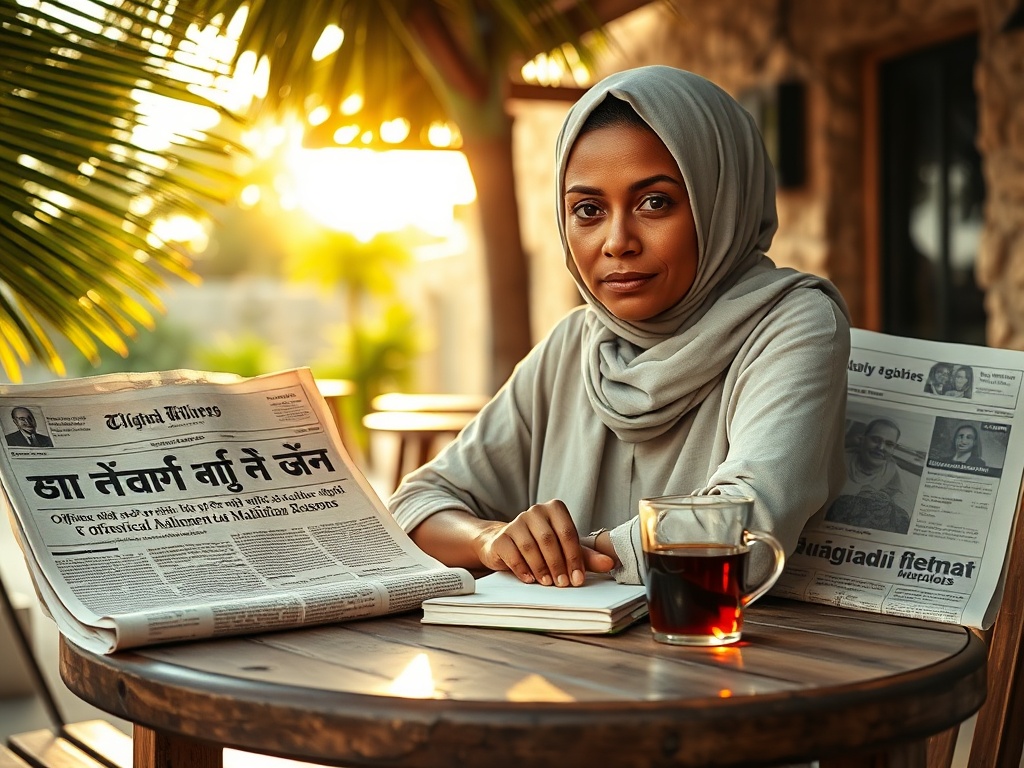
When Maldivian Newspapers Print the Same Story in Different Fonts
In the crowded information landscape of the Maldives, a troubling pattern has emerged—one where media outlets increasingly function as political amplifiers rather than independent voices. The criticism cuts deep: when narratives go unchallenged and reporting standards falter, the very foundation of public discourse weakens.
The complaint about "overwhelmingly pro-Israel narratives" serves as a microcosm of a broader media dilemma. When foreign policy coverage lacks balanced perspective, it reflects a domestic media environment where critical distance has become a rare commodity. This isn't merely about international affairs; it's about the mechanisms through which information reaches Maldivian citizens.
Across the archipelago, media organizations often align themselves along political fault lines, becoming either "pro-government mouthpieces" or opposition platforms. This binary positioning leaves little room for nuanced reporting or investigative rigor. The result is a public sphere where citizens navigate between competing narratives rather than accessing balanced information.
The ethical concerns run deeper than political alignment. When media organizations prioritize partisan loyalty over journalistic principles, they compromise their fundamental role as watchdogs and truth-tellers. The absence of rigorous fact-checking, the reluctance to challenge powerful interests, and the substitution of analysis with advocacy—all contribute to what critics describe as a system with "insufficient morals, ethics and very low standards."
This media polarization occurs against a backdrop of significant national challenges: economic pressures from rising living costs, governance questions surrounding public sector efficiency, and social concerns from youth unemployment to housing shortages. In such an environment, reliable information becomes not just desirable but essential for informed public participation.
The call to "End Vaanuvaa" represents more than a specific critique—it voices a broader yearning for media that serves the public rather than political masters. It speaks to an expectation that journalists should uphold ethical standards regardless of whose interests might be challenged.
As the Maldives navigates complex domestic and international waters, the need for independent, ethical journalism has never been more critical. The relationship between media integrity and democratic health remains inseparable—when one suffers, so does the other. The challenge ahead lies not just in recognizing these shortcomings but in building media institutions capable of withstanding political pressures while maintaining public trust.
— Source fragments: challenge overwhelmingly pro Israel narrative, MV media with no sufficient morals ethics & very low standards, pro gvt/opposition m.pieces