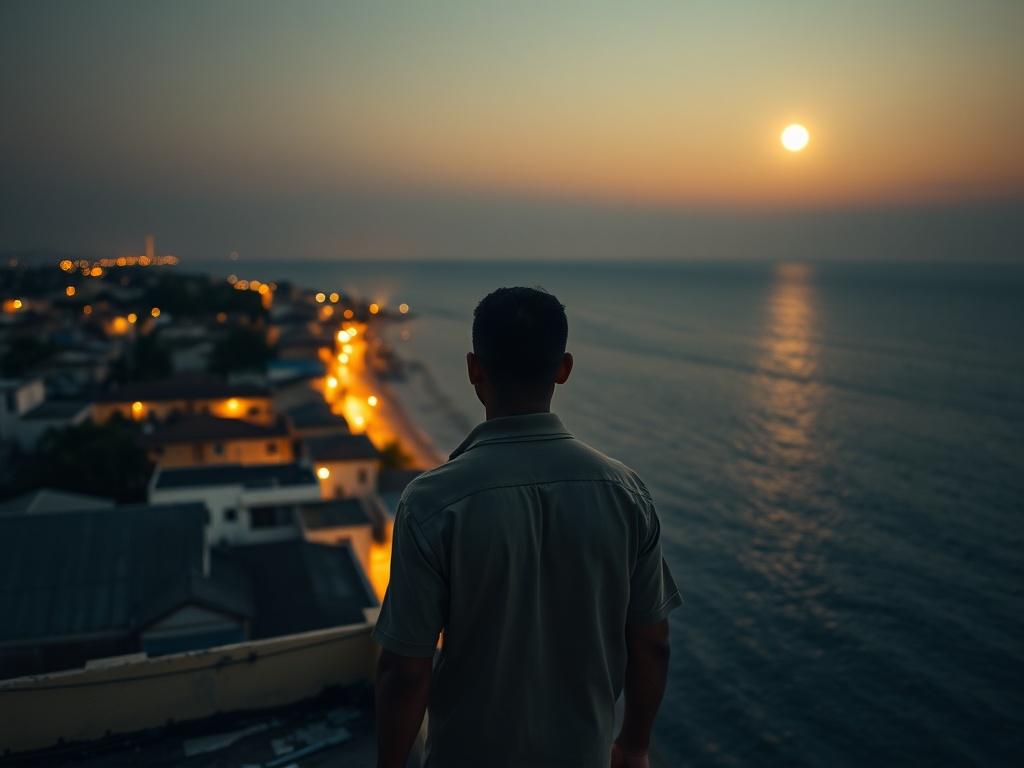
When Malé's Buildings Were Palm Trees
The ferry rocked gently as it approached Malé, the city rising from the sea like a concrete atoll. Ahmed watched the skyline take shape, remembering his grandfather's stories of when these buildings were palm trees, when the only walls were the reef that protected them all equally.
He had come from Laamu Atoll, carrying with him the salt-scented memories of wide lagoons and the communal rhythm of island life. In his bag was a letter—another rejection for housing. 'Not eligible,' it stated simply, as if his lineage could be reduced to bureaucratic checkboxes.
Walking through Malé's crowded streets, Ahmed felt the invisible lines that divided his country. He overheard conversations in tea shops—'Malé meeha this, atoll people that'—as if the sea that connected their islands had become a wall. He thought of his friend Hassan, born and raised in this concrete maze, who also couldn't secure housing despite his family living here for generations.
One evening, Ahmed climbed to the rooftop of a building where he was staying temporarily. The city spread below him, lights twinkling like stars that had fallen to earth. To the west, the sea stretched dark and endless, the same water that lapped against his home island's shore. He realized the absurdity of it all—they were all island people, all children of the same ocean, yet they had drawn lines in the water.
He remembered his father's words: 'The sea doesn't care where you're from. It will drown a Malé person as easily as an atoll person.' The thought wasn't morbid, but unifying. Their shared vulnerability should have been their greatest bond.
Down below, two children—one whose family had lived in Malé for centuries, another recently arrived from the south—played together, their laughter rising above the political divisions. They kicked a ball back and forth, their game flowing seamlessly across the concrete, unaware of the boundaries adults had constructed.
Ahmed looked at the construction cranes dotting the skyline, building new land, new opportunities. He wondered when they would start building bridges between people instead of just between islands. The true development his nation needed wasn't in concrete and reclamation, but in recognizing that every Maldivian deserved to feel they belonged to the entire archipelago, not just to one dot on the map.
As the moon rose over the Indian Ocean, casting its silver path across the water that connected all their islands, Ahmed understood that home wasn't a plot of land or a political designation. Home was the shared rhythm of the tides, the common language of the sea, the collective memory of a people who had always found their way across the waves.
— Source fragments: Malé supremacy will ruin rest of Maldives; Malé people deserve good housing; cannot be discriminated against as vazanveriya of Laamu atoll; why is there special treatment for you; discriminatory policy; belongs to elite Malé