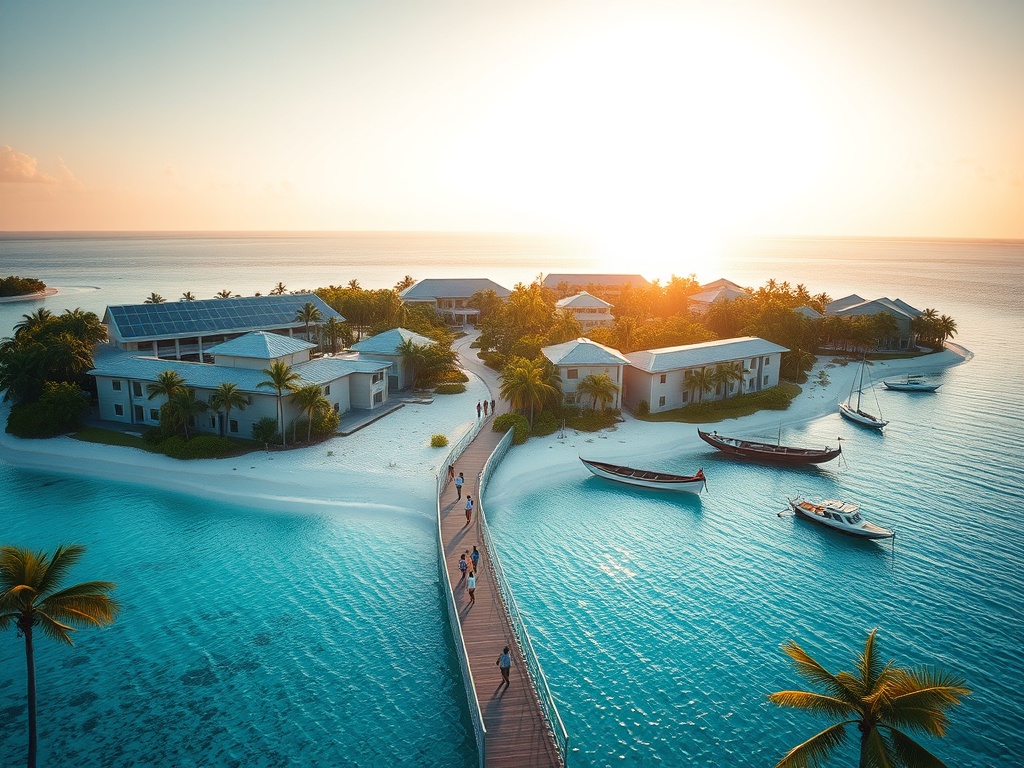
When Malé's concrete overshadows curriculum, the ocean waits
In a nation of nearly 1,200 islands, the concept of education remains curiously landlocked. The dominant model of higher education in the Maldives clusters institutions within the congested urban fabric of Malé, where concrete often overshadows curriculum and the ocean becomes merely a backdrop rather than an integrated classroom. This spatial confinement represents a missed opportunity in a country whose very identity is defined by its relationship with the sea.
The current approach treats university campuses as urban outposts rather than educational ecosystems. While existing institutions maintain multiple locations, they function more as administrative satellites than purpose-built learning environments. The conversation around educational reform now centers on whether the Maldives might benefit from a more radical reimagining—one that treats geography as an asset rather than a constraint.
Proponents of campus islands argue that such spaces could transform the educational experience. Imagine universities where marine biology students conduct research steps from their dormitories, where architecture programs engage directly with coastal sustainability, and where tourism studies unfold within functioning resort environments. This model would align education with the nation's economic pillars while creating immersive learning opportunities unavailable in traditional urban settings.
The practical benefits extend beyond pedagogy. Campus islands could alleviate pressure on Malé's strained infrastructure while creating new economic opportunities for local communities. They could serve as living laboratories for sustainable development, testing renewable energy systems, water management solutions, and eco-friendly construction methods relevant to the Maldivian context.
Critics might question the logistical challenges and costs, but the conversation has shifted toward viewing education as infrastructure investment rather than mere service provision. Just as the nation has pioneered innovative approaches to tourism, it could similarly revolutionize how it educates its citizens. The question is no longer whether such models are possible, but whether the Maldives has the vision to pursue them.
This reimagining represents more than physical relocation—it's about aligning educational spaces with national identity. In a country where the ocean defines everything from economy to culture, perhaps it's time for education to embrace this relationship fully, creating learning environments that are distinctly, authentically Maldivian.
— Source fragments: Universities in Maldives necessarily don't have to be confined to a set of tightly packed traditional buildings in a highly congested city. We can have a uni campus island or a chunk of an; They do but they're more like outposts. I'm talking about moving the main branch of the uni elsewhere while taking better advantage of our geography; Our geography is so unique yet we hardly take advantage of it