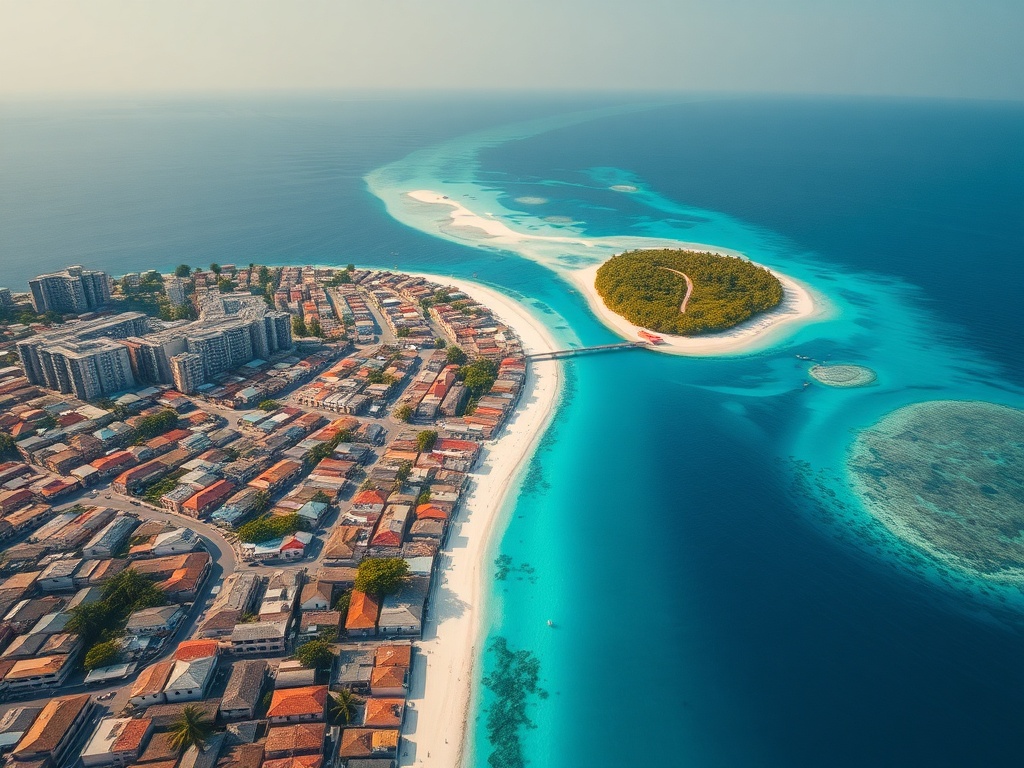
When Malé's Streets End and Island Life Begins
The debate over Maldives' urban future has reached a critical juncture. While some argue that population consolidation is necessary for a small island nation with limited space, others contend that the capital-centric development model has created more problems than it has solved.
Critics point to the paradox of a thousand-island nation where nearly half the population crams into less than two square kilometers. This concentration wasn't accidental but the result of decades of policy decisions that funneled resources, opportunities, and infrastructure toward Malé. The consequences are now visible in daily life: traffic congestion that turns short distances into hour-long commutes, air quality that deteriorates with each additional vehicle, and a social fabric strained by overcrowding.
The argument for decentralization gains strength when considering alternative development paths. Islands across the archipelago already possess the physical space to accommodate growth without the congestion plaguing the capital. Rather than forcing population movement through centralized planning, development could follow existing communities, enhancing what's already there rather than creating new concentrations of people.
Economic efficiency arguments for density often overlook the hidden costs. What appears as 'economies of scale' in theory manifests as quality-of-life deterioration in practice. The social toll includes alienation in crowded spaces, loneliness despite physical proximity, and crime rates that tend to rise with urban density. The vision of stacking communities in high-rises like the Hiyaa towers represents a fundamental misunderstanding of what makes places livable.
Transportation patterns reveal how infrastructure shapes behavior. The shift toward vehicle dependency has reached such extremes that walking even short distances has become uncommon, creating a self-reinforcing cycle where car-centric planning makes alternatives impractical.
The solution may lie in reimagining development as a distributed network rather than a centralized hub. Investing in islands with growth potential could create multiple centers of opportunity, reducing pressure on Malé while preserving the archipelagic character that defines the Maldives. This approach acknowledges that true development isn't just about economic efficiency but about creating communities where people can thrive—not just survive in crowded conditions.
As the conversation evolves, it's becoming clear that the question isn't whether Maldives needs development, but what kind of development serves both its people and its unique geography best. The answer may require moving beyond the assumption that concentration equals progress and embracing a more nuanced understanding of what makes communities work.
— Source fragments: WE DONT NEED A CAPITAL CITY OR ISLAND. THE EXISTENCE OF A CAPITAL CITY IS THE ROOT CAUSE OF ALL THE PROBLEMS WE ARE FACING TODAY!; We have grown so much towards vehicle use most will not even walk to the hosue next door; A country of a thousand islands, yet everyone is crammed into one. Not by choice, but by policy; Development should follow people, not the other way around; If we want livable cities, why not invest in the islands that already have space to grow; Everything is not about economies of scale; 'Population consolidation' is a nice word which hides the ugly truth of congestion, traffic jams, air pollution, alienation, loneliness and crime