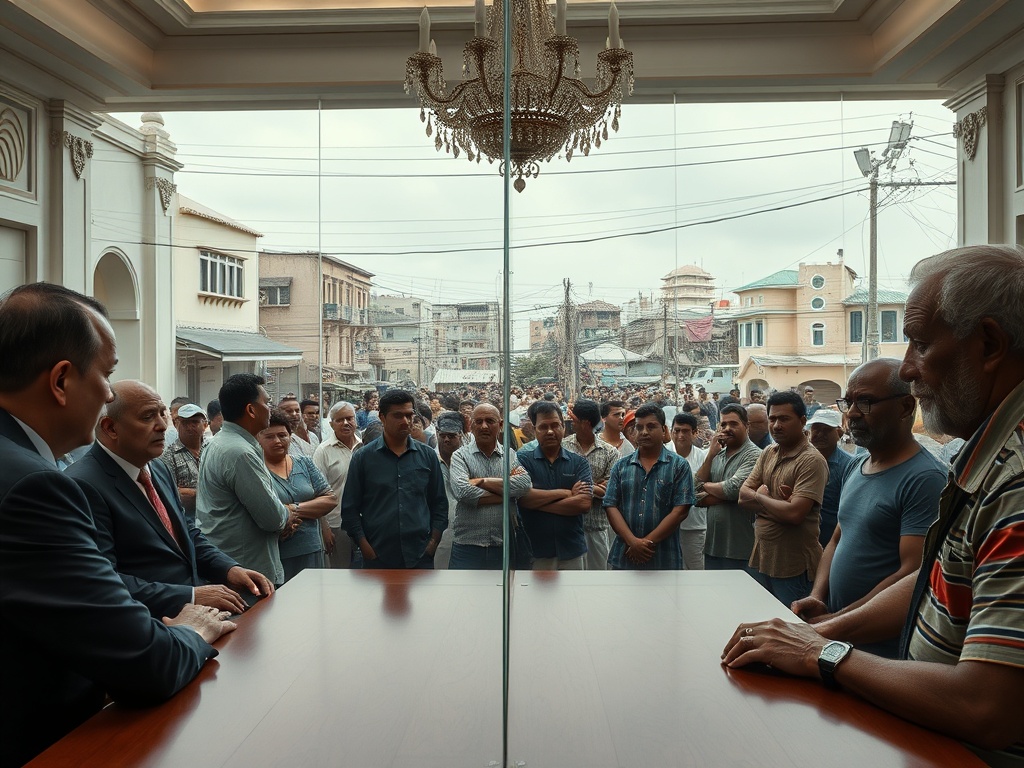
When Political Debates Happen Behind Glass Walls
In the swirling currents of Maldivian political discourse, a troubling gap has emerged between the language of power and the realities of daily life. The conversation has become so detached from the struggles of ordinary citizens that it risks losing all relevance to those it purports to serve.
The fundamental question haunting many Maldivians is simple yet profound: How can those struggling to survive be expected to solve systemic problems? When the cost of living continues to climb while opportunities remain scarce, political debates about abstract principles feel increasingly disconnected from the kitchen-table concerns that dominate most households. The expectation that compassion from the powerful will solve structural issues seems increasingly naive in a system where corruption and nepotism have become normalized.
This detachment manifests in multiple ways. The ability to casually cross political lines or access certain spaces becomes a visible marker of privilege in a society where many feel excluded from the very conversations that shape their lives. When fear prevents ordinary citizens from even approaching the corridors of power, the entire democratic process suffers. The observation that someone appears 'privileged to go inside that line' speaks volumes about the psychological barriers that have developed alongside the physical ones.
Meanwhile, the youth face a particularly stark reality. Drug use and unemployment create a vicious cycle that political rhetoric seems powerless to break. The comment that 'Maldives will never ever be free of gangs' reflects a deep-seated pessimism born from watching generations of political promises fail to materialize into meaningful change.
Some respond to this disconnect by dismissing politics altogether, advocating instead for a focus on personal enjoyment and material success. Yet this attitude itself reveals another layer of the problem—when the system appears so broken that engagement feels futile, the only rational response for many becomes individual survival rather than collective improvement.
The housing crisis in Malé exemplifies these tensions. As subsidized flats become political bargaining chips and are often subleased for profit by those living abroad, the basic need for shelter becomes another arena where the connected benefit while the disconnected struggle. Similar patterns repeat in healthcare, education, and employment, creating a society where the rules seem to apply differently depending on one's proximity to power.
What emerges is not just political disillusionment but a fundamental questioning of whether the current political class understands—or even cares about—the daily pressures facing ordinary Maldivians. When sensible statements become remarkable simply because of who utters them, it suggests the entire political environment has lost its moral compass.
The challenge for Maldives is not merely to improve political discourse but to rebuild the connective tissue between governance and lived experience. Until those in power demonstrate genuine understanding of what it means to navigate the high cost of living, housing shortages, and limited opportunities, political debates will remain what they have become for many: background noise in the struggle to survive.
— Source fragments: How are poor people supposed to help other poor people? You can only hope the rich or people in power are compassionate and not corrupt; out of touch with lived reality of Maldivians; Maldives will never ever be free of gangs; too serious about politics, chasing money and status; privileged to be able to go inside that line, feel scared to go in