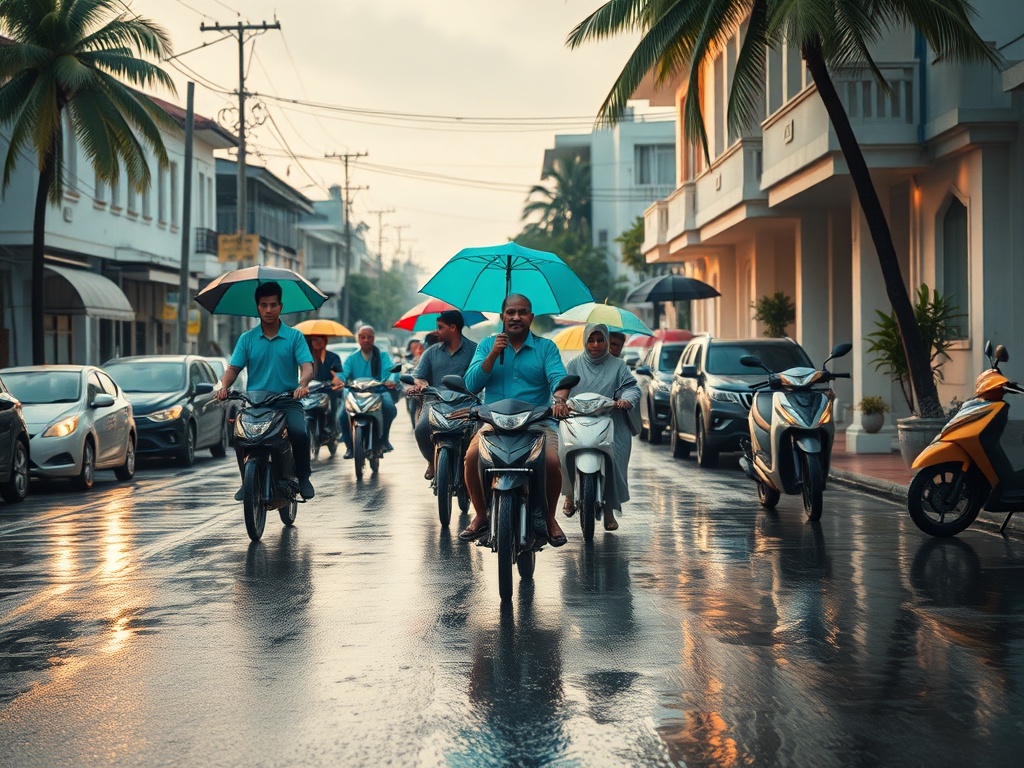
When Rain Turns Malé's Sidewalks Into Rivers
It begins with rain—a simple, natural event that transforms Malé's streets into obstacle courses. When the skies open, pedestrians are forced to abandon sidewalks and walk directly in the middle of traffic-choked roads. This isn't a choice but a necessity, a daily compromise between safety and mobility in a city where infrastructure has failed to keep pace with growth.
The problem extends beyond weather. In neighborhoods across the city, hundreds of vehicles park directly on roadways, consuming entire lanes and forcing traffic into dangerous configurations. Residents express frustration at the apparent lack of enforcement, questioning how such blatant obstruction of public space becomes normalized. The visual of parked cars occupying what should be flowing traffic lanes speaks to a deeper imbalance in how we prioritize space in our limited urban landscape.
Public transportation, often touted as the solution to urban congestion, remains an impractical alternative for many. When a simple bus ride requires a kilometer walk just to reach a stop, and costs escalate to over 600 rufiyaa for a single daily commute into Malé, the economic and practical calculus shifts decisively toward private vehicles. The system fails its fundamental purpose: public transport must be the easier option, not the more burdensome one.
This urban dilemma reflects broader challenges facing Maldivian infrastructure planning. As the population concentrates in the capital, the competition for space intensifies. The convenience of private vehicle ownership clashes with the reality of limited land, creating a zero-sum game where pedestrians consistently lose. The evidence from cities worldwide shows that transit improvements must precede behavioral change, yet here we see the reverse—infrastructure struggles to catch up with entrenched habits.
The solution requires reimagining urban mobility as an integrated system rather than a collection of competing interests. Dedicated pedestrian corridors, enforced parking regulations, and truly accessible public transport that considers actual user experience could transform these hazardous streets into functional thoroughfares. Until then, walking in the road during rainfall remains a stark reminder of whose mobility we value—and whose we've left behind.
— Source fragments: why not recommended? have you tried walking on the streets when it rains? pedestrians have to walk in the middle of the road; Don't care. Until they don't do anything about the hundreds of cars parked in the LITERAL ROAD in phase 2.. how is that allowed ????????? Taking up an entire lane?????; Have you seen a road in Male'? If I have to walk 1km to find a bus, I'll obviously choose the other option. Publicly transport has to be the easier option to choose when it comes to transport. Currently we have to psy 600+ per person to commute once a day to Male'