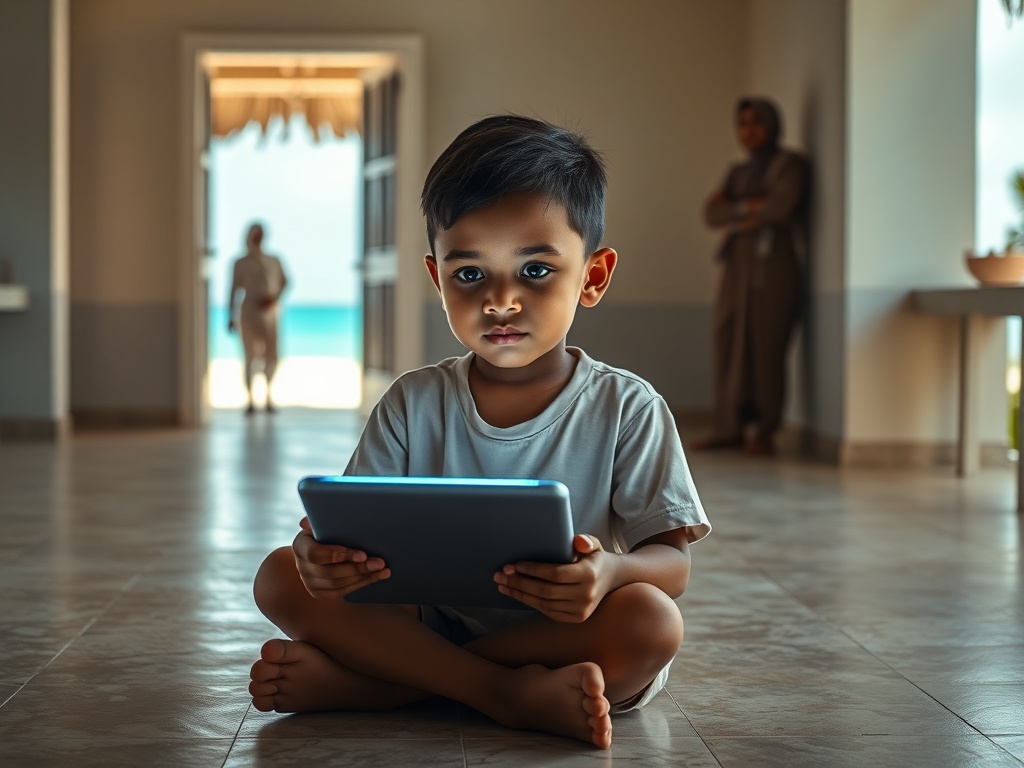
When Screens Become the Babysitter in Maldivian Homes
Another day, another story surfaces about children facing consequences beyond their understanding. The collective sigh echoes across Maldivian households: "Protect the children of this country." Yet this plea seems to fall on deaf ears as parents increasingly delegate their fundamental responsibilities to institutions and devices.
The digital age has introduced a new form of parental neglect, disguised as convenience. Screens have become the modern pacifier—a guilt-free solution for busy parents. Children as young as primary school age now form their social circles on platforms like Roblox, where exclusion begins for those without access. These virtual playgrounds, while entertaining, lack the supervision and guidance children desperately need.
Meanwhile, schools bear the burden of addressing issues that should begin at home. When conflicts arise between children, some parents escalate minor incidents to social media, never considering the lasting consequences their actions might have on their own children. The question becomes: who is really protecting these young minds?
This trend reflects broader societal shifts in the Maldives. As families grapple with rising living costs and economic pressures, quality time becomes the first casualty. The result is a generation learning social cues from algorithms rather than family interactions, forming relationships in digital spaces without understanding real-world consequences.
The situation raises difficult questions about what constitutes protection in modern Maldivian society. Is it simply keeping children safe from physical harm, or does it extend to safeguarding their emotional development, social skills, and moral compass? As one observer noted, when both educational and nurturing roles are outsourced, we risk creating children who are technically connected yet emotionally isolated.
The solution requires a collective awakening—a recognition that no app, game, or school curriculum can replace engaged parenting. In a nation proud of its close-knit community values, we must ask whether we're sacrificing our children's development at the altar of convenience. The screens won't protect them; only we can.
— Source fragments: Protect the children of this country; Why did we even drag something happened between kids to sm; parents rely too much on schools to educate and neglect their roles; screens are made available as a means of guilt freeing their neglect towards kids; kids have started forming social circles on harmful platforms