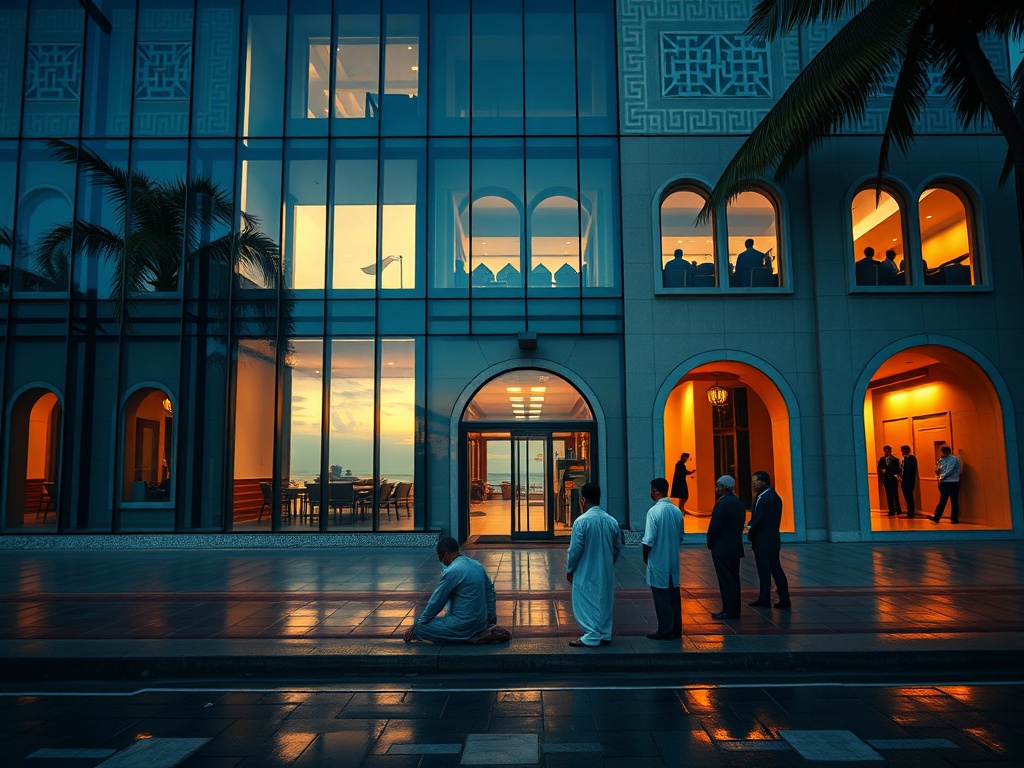
When the Bank Manager is Your Brother
The afternoon prayer call echoes across Malé, reaching from the crowded streets to the glass towers where decisions are made. In this small archipelago where we all know each other, where the man counting your loan interest might have prayed beside you last Friday, the question of conscience becomes deeply personal.
We speak of haram earnings as if they happen in some distant, foreign land. But here, in our homogeneous Muslim society, the bank manager isn't a faceless corporation—he's Ahmed from two streets over, Fatima's cousin, the father who brings his children to the same Quran class as yours. The buildings don't sin; the people inside them make choices. And when those choices affect millions, when they touch the savings and dreams of our neighbors, the silence becomes a collective burden.
There's a particular weight to confronting sin when the sinner shares your faith, your culture, your small island home. It's easier to protest foreign influences, to point fingers at distant powers. But what happens when the system we critique is run by people who break fast with us during Ramadan, who celebrate Eid in the same mosques?
The awareness we seek to raise isn't abstract theological debate—it's about looking our neighbors in the eye and asking difficult questions. It's about recognizing that in a society this small, every transaction carries not just financial weight but spiritual consequence. The noise we make isn't meant to shame individuals but to awaken collective conscience, to remind each other that our faith should guide not just our prayers but our professions.
Perhaps the challenge isn't just about banking systems but about the spaces between our religious ideals and our daily realities. In these islands where the sea connects everything, where news travels faster than the speed of official statements, our shared faith becomes both comfort and accountability.
— Source fragments: why let them earn haram when we know it? we are a homogenous society... we are all muslims so the bank manager is also a muslim