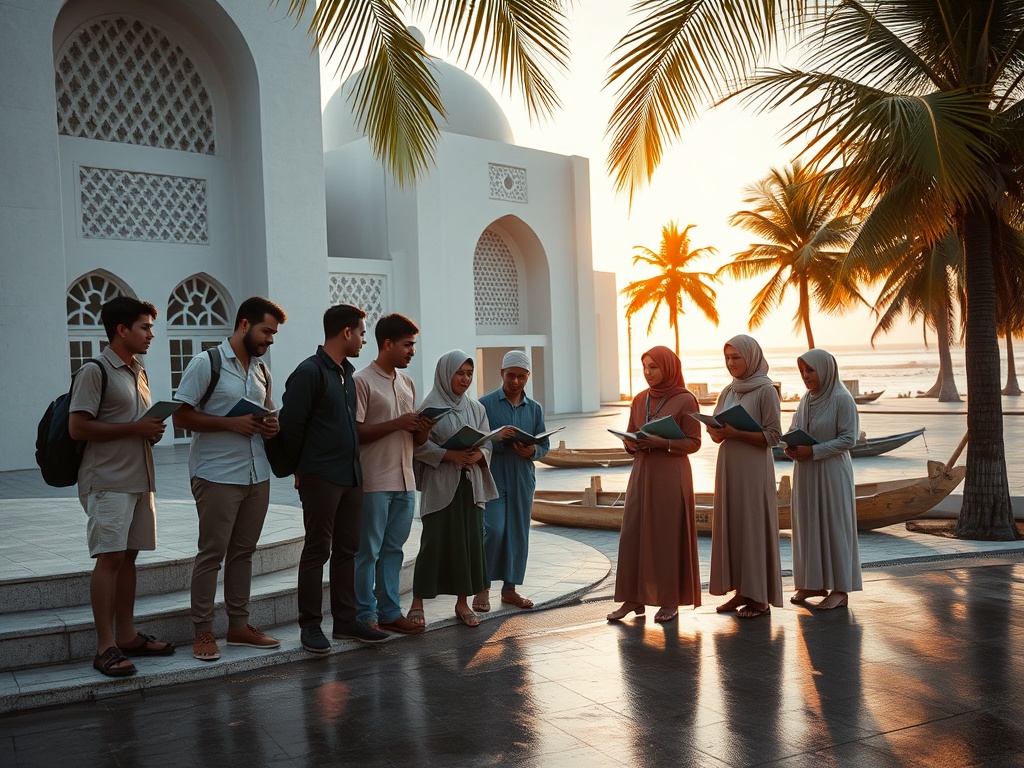
When the Call to Prayer Meets the Science Textbook
In the heart of Malé's crowded streets, where the call to prayer mingles with the hum of modern life, a quiet intellectual tension simmers beneath the surface of Maldivian society. It's a conversation about how to reconcile the certainties of faith with the questions raised by science, particularly when it comes to theories like the Big Bang and human origins.
The debate isn't about faith versus science in the Western sense, but rather about establishing the proper hierarchy of knowledge. For many Maldivians, the Quran stands as the ultimate standard of truth—a position articulated clearly in recent discussions. The question isn't whether the Quran agrees with scientific theories, but whether those theories align with divine revelation. This perspective reflects a broader Islamic epistemological framework where revealed knowledge takes precedence over human discovery.
Yet the conversation reveals nuanced positions. Some argue against what they see as unnecessary attempts to validate scientific theories through Quranic interpretation. They question the value of stretching religious understanding to accommodate theories that, in their view, fundamentally operate outside a theological framework. As one perspective noted, early Islamic scholars might have viewed such reconciliation efforts with suspicion, seeing them as potentially compromising the purity of faith.
The discussion extends to human origins, where the Quran's account of Adam's creation from dust stands in contrast to evolutionary theories. Here, the lines are more sharply drawn, with many seeing direct contradiction rather than potential alignment. The conversation reveals a community wrestling with how to maintain religious certainty while engaging with scientific paradigms that dominate global discourse.
This tension plays out against the backdrop of Maldivian society, where 100% Muslim identity coexists with rapid modernization. The same society grappling with political challenges and economic pressures must also navigate these deeper questions of knowledge and belief. The debate isn't abstract—it touches on education, public discourse, and how a small island nation positions itself between tradition and global scientific consensus.
What emerges is neither outright rejection nor uncritical acceptance, but a thoughtful engagement that prioritizes religious truth while acknowledging the complexity of modern knowledge systems. It's a conversation that continues to evolve, reflecting the dynamic relationship between faith and reason in contemporary Maldivian life.
— Source fragments: Discussions about Quran as ultimate standard of truth, Big Bang theory reconciliation attempts, questioning the need for religious validation of scientific theories, contrast between Quranic creation narrative and evolutionary theory