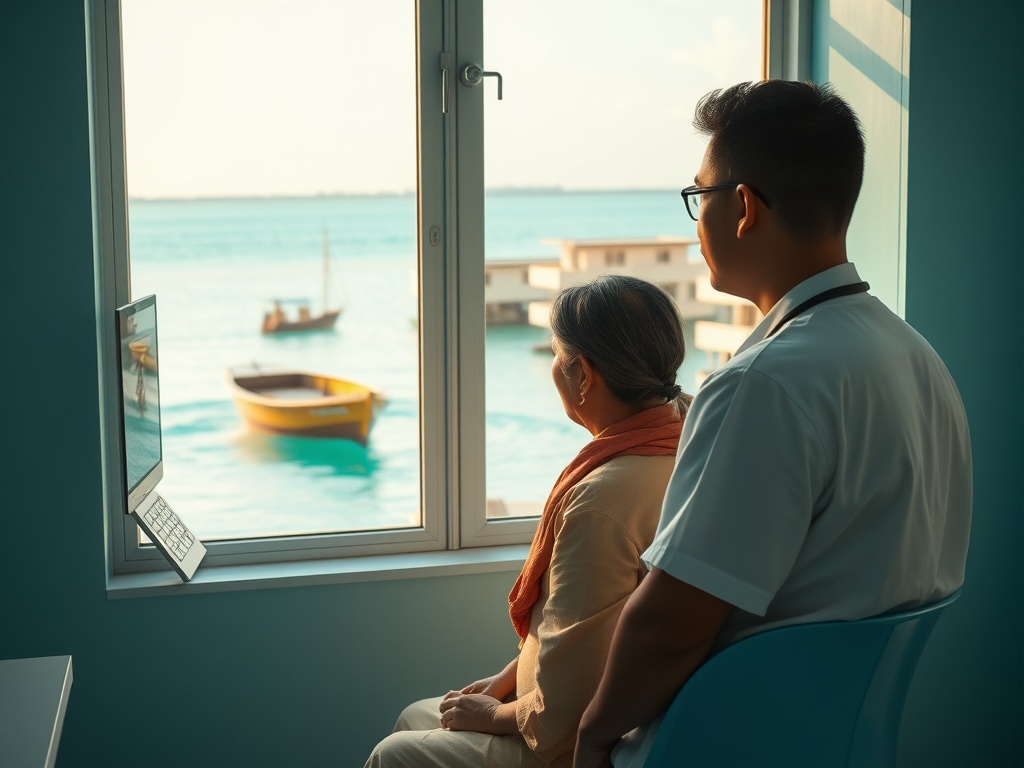
When the Doctor Is a Screen and the Hospital Is 300 Kilometers Away
The scattered islands of the Maldives have long presented unique challenges for healthcare delivery. With populations dispersed across vast ocean distances, accessing specialized medical care often requires expensive travel to the capital or abroad. Yet recent developments suggest a potential turning point, where technology and strategic planning could fundamentally reshape the healthcare landscape.
Remote surgery technology represents one of the most promising frontiers. For a nation where world-class specialists cannot be present on every atoll, telemedicine offers a revolutionary solution. The ability for doctors to operate remotely could bridge the geographical divide that has historically limited medical access. This isn't merely about convenience—it's about survival in emergencies and quality of life for chronic conditions. The technology could transform IGMH and regional hospitals from isolated facilities into connected nodes in a national medical network.
The previous government's regionalization strategy demonstrated how thoughtful policy can make a tangible difference. By decentralizing healthcare services and strengthening facilities in the north and south central regions, the system became more resilient. The COVID-19 pandemic served as a crucial test case, revealing how distributed healthcare infrastructure could manage crises more effectively than a centralized model alone. This approach recognized that Maldivians outside Malé deserve quality care without the burden of expensive travel.
International patients have noted the accessibility of public healthcare services, with reasonable additional fees for foreigners accessing dental and medical care. This suggests a system capable of serving diverse populations while maintaining affordability. The positive experiences with effective medications—including those providing genuine relief from stress and anxiety—highlight the importance of having proper pharmaceutical care available locally.
Of course, technological solutions must be balanced with human touch and cultural understanding. The discussion around vaccines and medical science reflects ongoing public education needs. As the Maldives moves forward, building trust in evidence-based medicine will be crucial for public health initiatives.
The path forward requires continued investment in both technology and human resources. Training local healthcare professionals while integrating advanced telemedicine capabilities could create a hybrid model uniquely suited to the Maldivian context. This approach acknowledges the realities of being a small island nation while refusing to accept second-rate healthcare as inevitable.
What emerges is a vision of Maldivian healthcare that leverages the nation's strengths—its interconnected island communities, growing digital infrastructure, and determined medical professionals—to overcome geographical challenges. The goal isn't to replicate systems from larger countries, but to innovate solutions that work for the specific realities of island life.
— Source fragments: Hope we receive this technology in our IGMH one-day soon. Being a small country we may not be able to get world class doctors in every field. But if doctors can operate remotely we could benefit so much; Regionalization of health did wonders for the wellbeing of those in the north and south central; was able to get healthcare from public hospitals, got some dental services too by only paying an additional 50rf