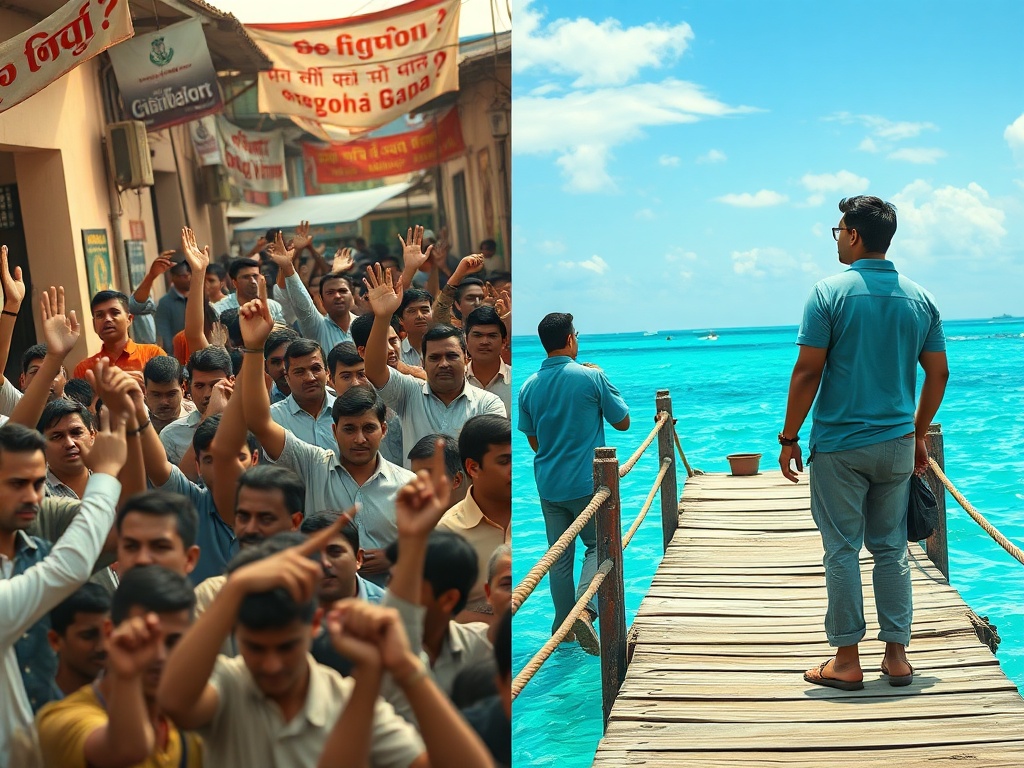
When the Majority's Roar Drowns Out the Single Voice on the Jetty
The democratic experiment in the Maldives has reached a critical juncture, where the very mechanisms designed to ensure fair representation now appear to be working against it. Across social media platforms and private conversations, a palpable frustration emerges—not with democracy itself, but with the distorted version that has taken root in our islands.
The core complaint echoes through the atolls: majority rule has become majority tyranny. When supermajorities can bulldoze minority voices through brute voting power, the essence of democratic deliberation vanishes. This isn't merely about losing elections—it's about a system where meaningful opposition becomes impossible, where dissenting voices are systematically marginalized rather than incorporated into governance.
The constitutional amendments pushed through without genuine public engagement represent more than procedural failures—they signal a deeper legitimacy crisis. When changes to the fundamental law of the land bypass the people they're meant to serve, democracy becomes a hollow shell. The frustration isn't confined to any single party or faction; it cuts across generational and political lines.
Our electoral system compounds these problems. The fact that an MP can technically be elected with fewer than 10% of votes reveals a structural flaw that undermines representative government. Meanwhile, the absence of recall mechanisms leaves constituents powerless against unresponsive representatives once elections conclude. This isn't democracy—it's elective dictatorship in five-year increments.
The independence of our institutions has become similarly compromised. When every commission operates at the pleasure of the sitting president, checks and balances exist in name only. The system appears designed not for governance but for control, with power flowing downward from the executive rather than upward from the people.
Even well-intentioned reforms like quotas have been co-opted, becoming just another form of political patronage rather than genuine empowerment. The result is a system that looks democratic on paper but functions as an oligarchy in practice.
Younger Maldivians watching this unfold have grown understandably cynical. Their 'whining' on social media, as some dismissively call it, represents not apathy but engagement—a desperate attempt to be heard when formal channels have failed. The real question isn't why they complain, but why the system gives them so much to complain about.
True reform requires more than tinkering at the edges. It demands fundamental rethinking of how power is distributed, how minorities are protected, and how institutions can be made genuinely independent. Until then, our democracy will remain incomplete—a promise unfulfilled, a system waiting to become what it claims to be.
— Source fragments: Our whining has done more meaningful change than the system your generation designed; MP recall is not possible under the current system; how can you solve the problem of having the minority voice not being heard because the super duper majority tosses out their little voice by brute force vote; The entire system needs real reform; Every independent commission still operates at the will of the sitting president