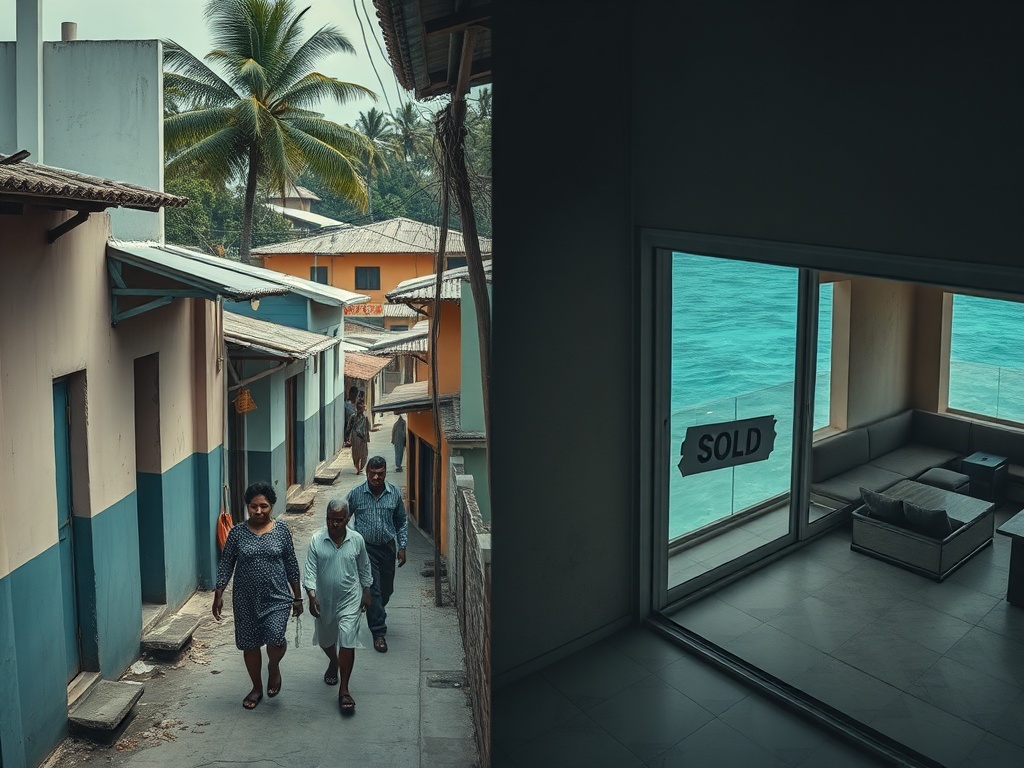
When Your Housing Application Meets a Politician's Promise
In the crowded archipelago of the Maldives, few issues cut as deep as land. It is the ultimate symbol of belonging, stability, and legacy. Yet, in recent years, it has also become the currency of political patronage, a tool wielded by successive governments to secure loyalty and votes. The current debate over housing allocations—whether labeled Binveriyaa, Gedhoruvaa, or any other name—is merely the latest iteration of a familiar pattern. What has changed, however, is the public’s diminishing patience with the entire system.
Critics argue that these schemes are less about addressing genuine housing needs and more about rewarding political allies and business stakeholders. They point to instances where individuals with existing properties, some living abroad, have secured additional land or flats through these programs. This has fueled perceptions that the system is gamed by those with connections, while many genuine applicants from overcrowded urban centers remain in limbo. The result is a growing sentiment that these initiatives are designed not to solve a crisis, but to perpetuate a cycle of dependency and electoral favor.
The role of state-owned enterprises like HDC (Housing Development Corporation) has come under particular scrutiny. Regardless of which administration is in power, these entities are seen as enablers of a flawed model—one that prioritizes political expediency over transparent, equitable urban planning. The allegation is that well-connected construction companies and developers benefit disproportionately from land distribution models, turning public need into private profit. This has led to widespread cynicism, where citizens view each new announcement with skepticism, anticipating another round of selective benevolence.
At the heart of this disillusionment is a broader erosion of trust in institutions. When land—a finite and emotionally charged resource—is distributed in ways that appear arbitrary or biased, it reinforces a narrative of two Maldives: one for the connected, and one for the rest. This is not merely a housing crisis; it is a crisis of legitimacy. The political rhetoric may shift from election to election, but the public’s verdict is increasingly unanimous: until the process is cleansed of favoritism and opacity, no government can credibly claim to champion justice or development.
The danger for any ruling party is that these schemes, initially launched as populist measures, can quickly become liabilities. When citizens begin to view them as scams rather than solutions, the very tools meant to consolidate power can hasten its erosion. As the 2028 elections loom, the question is not which party will promise the most, but which will restore faith in the system itself. For now, the public conversation remains dominated by a simple, searing demand: development without justice is not development at all.
— Source fragments: MDP is all abt corruption and laadheeny now; HDC could have stopped it; free goathi matters to stakeholders; Binveriyaa was a scam to get votes; those who have taken advantage of the system benefit; injustice triumphs over justice