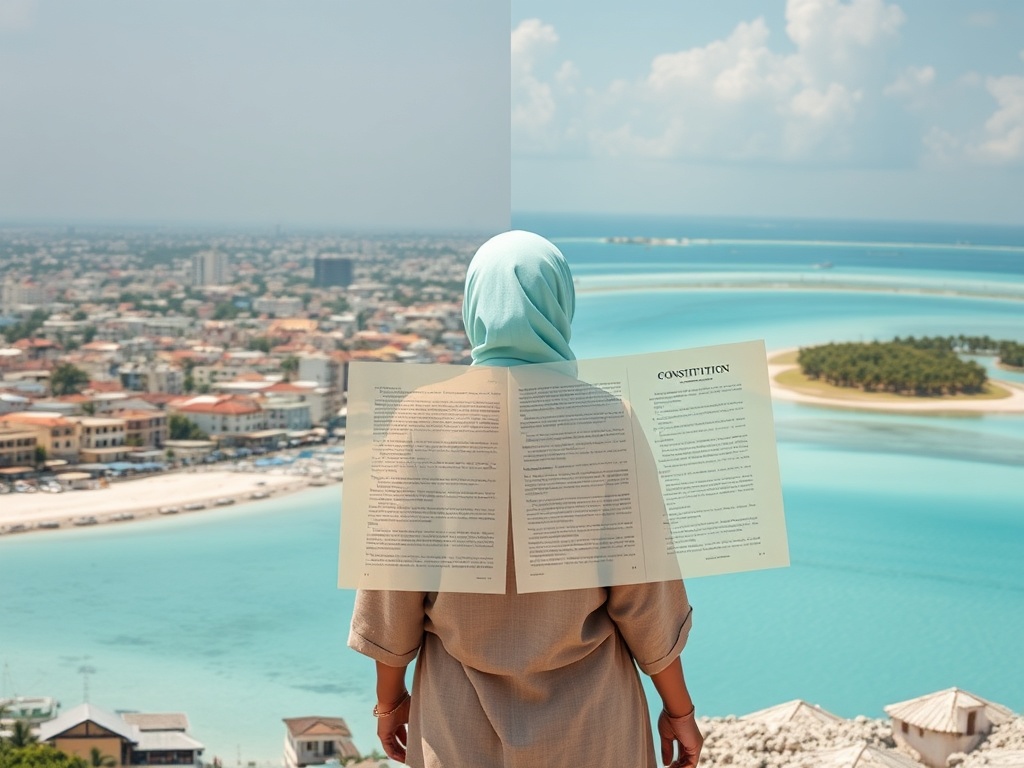
When Your Right to Move Anywhere Meets the Island You're From
The constitution is clear: every Maldivian citizen has the right to migrate to any inhabited island without restriction. Yet this constitutional guarantee increasingly collides with a more complex reality where geography, ancestry, and economic status determine one's place in the national hierarchy.
Across social media platforms and public discourse, citizens express frustration with what they perceive as a gap between constitutional rights and lived experience. The debate centers on Malé, the densely populated capital that has become both aspiration and exclusion zone. "It was created for birds, corals and fish," one perspective notes, referencing the massive reclamation and infrastructure investments that transformed the city. "We all paid for the city. Is it too much to ask for same rights?"
The fundamental tension lies in what critics describe as a contradiction between the nation's unitary state designation and the practical limitations on residency rights. The constitutional question-and-answer section explicitly guarantees settlement rights throughout Maldivian territory, yet many feel these rights are effectively reserved for "a small group of people with Malé DNA and the rich elites."
This perceived hierarchy extends beyond geography to questions of basic human dignity. Recent incidents involving authority figures have sparked conversations about compassion and dehumanization in public service. When citizens in need of help encounter systems that seem designed to control rather than serve, it raises deeper questions about whose dignity matters in the public sphere.
The language of discrimination has evolved beyond traditional categories. As one observer framed it, authorities employ "a thought process akin to 'jus sanguinis'"—the principle of citizenship by blood—to discriminate against citizens within the nation's own borders. This unspoken hierarchy manifests in how people are characterized, with some being portrayed as "opportunists" while being restricted from basic rights.
Critics argue that these contradictions create chaos nationwide through theories of "elitism" that promote division and hate speech. The very principles meant to unite—constitutional guarantees, human rights standards, civil codes—appear to be bending under the weight of unwritten rules that determine who truly belongs where.
The conversation reveals a nation grappling with its identity at a crossroads. Can a country maintain its unitary character while some citizens feel like "second-class citizens in our capital"? The debate isn't merely about residency permits or housing allocations, but about the soul of a nation that promises equality while practicing subtle forms of exclusion.
As these discussions unfold, the core question remains unanswered: How does a nation reconcile its constitutional ideals with the complex realities of limited space, economic disparity, and historical privilege? The answer may determine whether the Maldives moves toward genuine inclusion or deeper fragmentation.
— Source fragments: The constitution of Maldives says every citizen has right to migrate to any inhabited island without any restrictions; The fundamental issue is calling us a unitary state and writing in QA that we have rights to settle anywhere within the Maldivian territory; posing them as 'opportunists', restricting them of basic rights; We all paid for the city. Is it too much to ask for same rights Why are we second class citizens in our capital; ‘Jus sanguinis’ is a normative concept used in citizenship law; however, we are using a thought process akin to it to discriminate citizens within the borders of our State