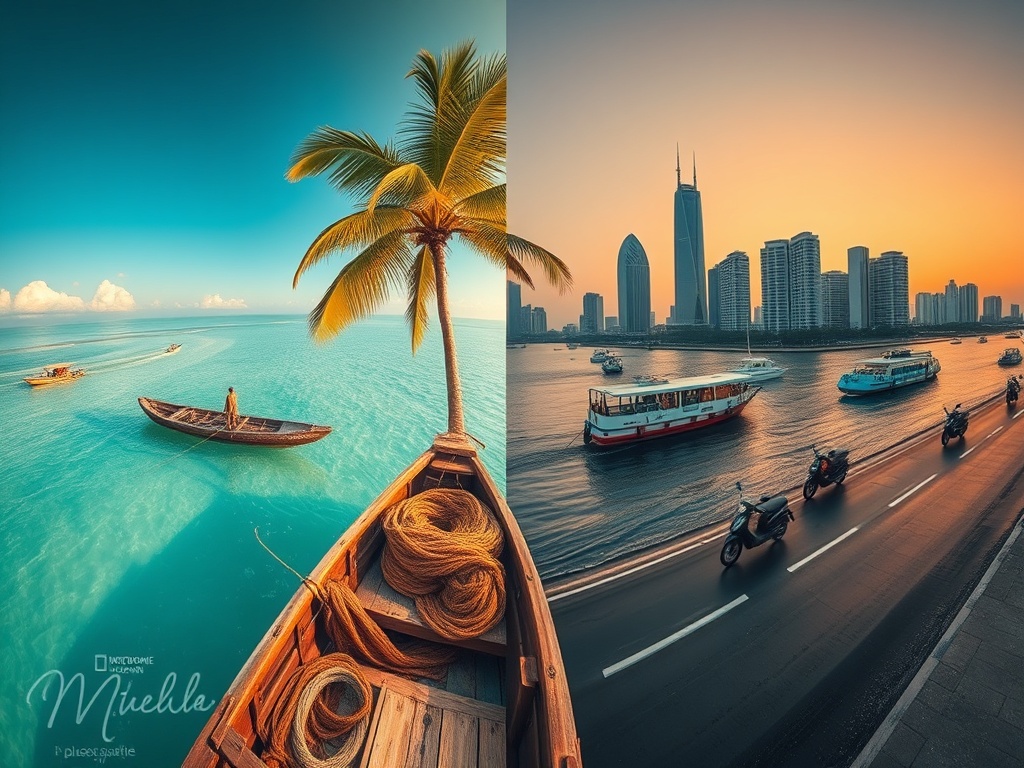
When Your Vote Lives on an Island You No Longer Call Home
In the wake of recent elections, a quiet revolution is brewing across the Maldives' scattered atolls—not in the halls of power, but in the daily lives of citizens questioning the very foundations of their political identity. The debate over permanent address versus residence-based voting has become the unlikely focal point for broader frustrations about representation, mobility, and what it means to belong in a nation of islands.
For generations, the permanent address system tethered Maldivians to ancestral islands, creating political constituencies that often bore little resemblance to where people actually lived and worked. Today, as thousands migrate to Greater Malé for education and employment, this system increasingly feels like an anchor to a past that no longer exists. 'Why should I vote for a council in an island I have never ever lived in my whole life?' one citizen asks—a question echoing through crowded coffee shops and social media feeds.
The current system creates political distortions that ripple through governance. With an estimated 40 parliamentary seats potentially concentrated in Greater Malé under residence-based voting, the geographical balance of power would shift dramatically. Critics argue this would better reflect where Maldivians actually live, while others worry about marginalizing outer islands. Yet the debate reveals a deeper truth: Maldivians are reimagining the relationship between land, community, and political voice.
This isn't merely an administrative discussion—it's about the right to redefine home in a nation where mobility has become fundamental to survival. Young professionals who shuttle between islands for work, families split across atolls for education, and seasonal workers moving with tourism flows—all find themselves politically homeless under the current system. The permanent address, once a source of cultural identity, now feels like a bureaucratic fiction separating citizens from meaningful political participation.
Simultaneously, disillusionment with established political parties has reached a tipping point. The perception that both major parties are dominated by 'old and tried' politicians unable to address core issues has sparked calls for new political movements. The electoral calculations—where parties allegedly pivot strategies between rounds to capture specific voter blocs—only deepen public skepticism about whether current structures can deliver genuine representation.
As one observer notes, the damage may already be done, but the conversation continues. The demand for a 'Maldives 2.0' reflects not just technological aspiration but a fundamental rethinking of how democracy should function in an archipelagic nation. The question is no longer whether the system should change, but how to build something that honors both the tight-knit communities of outer islands and the fluid realities of modern Maldivian life.
What emerges is a nation at a crossroads, where the technicalities of voter registration have become symbolic of larger struggles over identity, belonging, and political renewal. The solution may lie not in copying foreign models but in developing something uniquely Maldivian—a system that acknowledges both the enduring pull of ancestral homes and the practical realities of a mobile, interconnected population seeking their place in a rapidly evolving nation.
— Source fragments: Where you live is the only address the govt needs to consider for anything, period; Why should I vote for a council in an island I have never ever lived in; MDP still hasn't crunched the numbers on how they lost; Maybe it's time to leave MDP and PNC behind; The neutrals need to start a political movement