Where Flags Fly and Doorways Hold Silent Witness
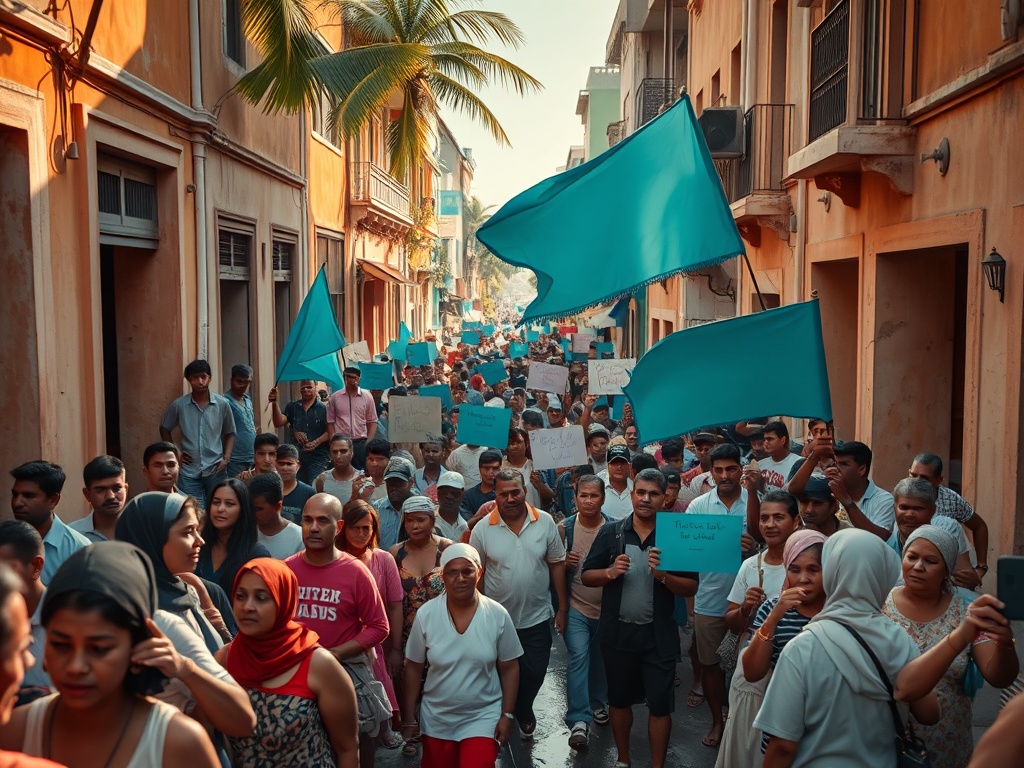
The streets of Malé swell with bodies, a river of humanity flowing toward some unseen center. Thousands move with purpose, drawn by the magnetic pull of political allegiance. They come to show support for their "King," their leader—the figure who commands such devotion in this island nation where politics has become both spectacle and sacrament.
From the edges of the crowd, the scene takes on a different texture. The fervor of the faithful contrasts sharply with the weary resignation of those who watch from the sidelines. "Nothing surprises us anymore," echoes the sentiment of those who have witnessed too many political seasons, too many promises that dissolved like monsoon rain on hot asphalt.
This division speaks to something fundamental in the Maldivian psyche—a nation torn between the comfort of strong leadership and the painful awareness of its costs. The capital city, already straining under the weight of congestion and housing shortages, now bears the additional burden of this political theater. While some find purpose in collective adoration, others see only the familiar patterns of power consolidation.
In a country where governance has become increasingly centralized and political rights face erosion, such displays take on added significance. The very language of royalty applied to elected officials hints at a transformation in how power is perceived and exercised. The distance between ruler and citizen grows, even as the crowds press closer.
The economic realities that shape daily life here—the high cost of living, the housing crisis, the competition for jobs—seem momentarily suspended in the political spectacle. Yet they remain, waiting to reassert themselves when the banners are folded and the speeches fade.
What does it mean when a people begin to describe themselves as "evil" in their political choices? This self-condemnation suggests a profound disconnect between action and conscience, between the collective will and individual morality. It speaks to the weariness of a populace that has seen corruption scandals, nepotism, and the systematic hollowing out of institutions, yet still participates in the pageantry of power.
The gathering in Malé is more than a political rally—it's a mirror held up to a society at a crossroads. The devotion on display exists alongside deep-seated cynicism, the hope for strong leadership tempered by the memory of its consequences. In the space between these extremes, the future of Maldivian democracy will be written.
— Source fragments: Thousands of Maldivians are flocking to Male' to show their support to their "King" and leader. Nothing surprises us anymore. Our people are evil.