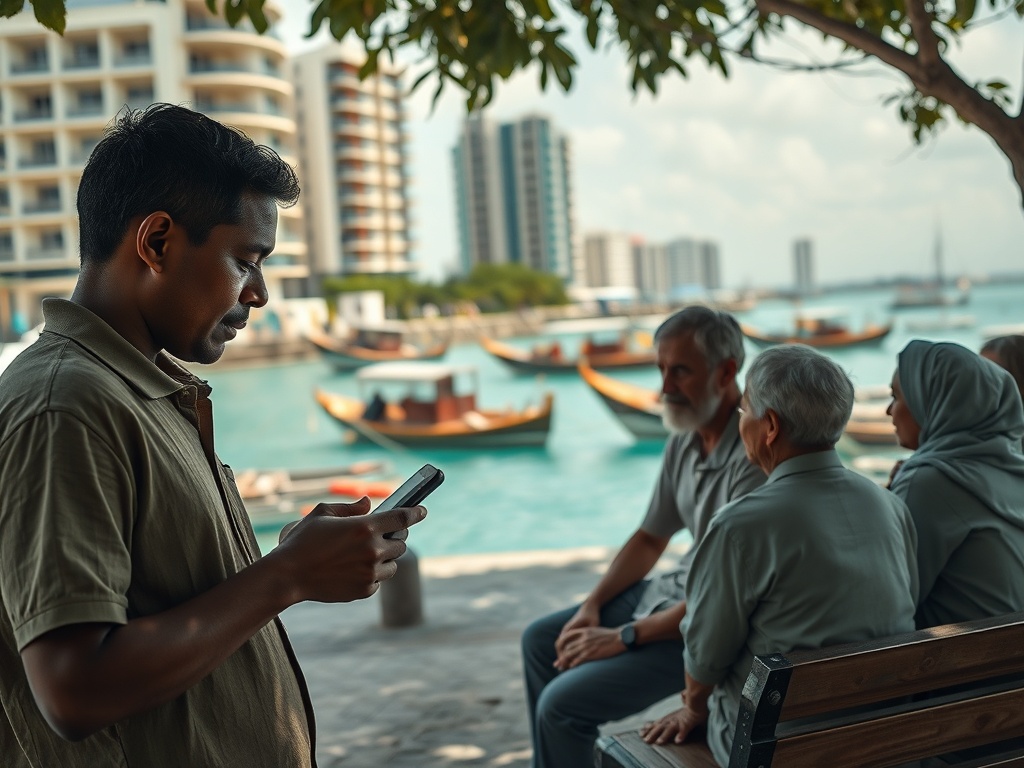
Where Maldivian Political Debates Echo but Never Meet
The digital squares of Maldivian social media echo with a familiar refrain: the country remains fundamentally divided on core issues, and no amount of online debate seems capable of bridging these chasms. This recognition has prompted a deeper questioning of political engagement itself—what constitutes effective advocacy, and where does the line between policy and personality truly lie?
Across platforms, users note the disconnect between vocal online communities and the offline critical mass that ultimately determines electoral outcomes. Political parties understand this dynamic well, with one observer noting that the ruling MDP particularly recognizes that social media volume doesn't necessarily translate to polling station results. This awareness shapes political strategy, creating a parallel reality where online discourse and ground-level political work often operate in separate spheres.
The search for political identity in this environment has become increasingly complex. When one user questioned whether their advocacy for land redistribution, universal basic income, and job guarantees qualified them as socialist, the response highlighted the fluidity of political labels in the Maldivian context. The very term 'Maldivian socialist' prompted curiosity and confusion, suggesting that traditional ideological categories may not neatly apply to local political realities.
This ideological ambiguity reflects a broader challenge: how to articulate policy positions without being reduced to partisan combat. Multiple voices emphasize speaking for oneself rather than any party, with one participant explicitly stating they don't target specific communities or accuse them of social and economic advantages. This represents a conscious effort to elevate discussion above personal attacks and focus on substantive policy differences.
The conversation repeatedly returns to institutional accountability, with users questioning whether elected representatives truly advocate for their constituents' interests. The geographical distribution of parliamentary representation—76 lawmakers representing islanders versus 17 representing Malé—raises fundamental questions about political voice and resource allocation. Calls to directly contact MPs reflect a desire to bridge the gap between public concern and political action.
Yet beneath these practical discussions lies a more profound recognition: some divisions may be permanent features of the political landscape. As one participant noted, certain issues will always divide the country, necessitating alternative solutions beyond political consensus. This pragmatic acceptance of disagreement represents a maturation of political discourse, moving beyond the expectation that every debate must end in resolution.
The challenge facing Maldivian democracy is not merely one of political differences but of developing mechanisms for constructive engagement across those differences. As the conversation demonstrates, the center—both ideologically and geographically—struggles to hold amidst competing visions for the nation's future. The real test may be whether Maldivian politics can develop spaces for dialogue that acknowledge permanent divisions while still working toward common goals.
— Source fragments: Good that you realized you have crossed the line between policy and persons; The online crowd is vocal online. it doesn't correlate with offline reality; I don't call myself a socialist but I have been tweeting about giving away land, giving ubi, giving job as a right; This is not a PNC campaign trip; It's an issue where the country will always be divided on; Let's demand our MPs. Text your MP on this regard