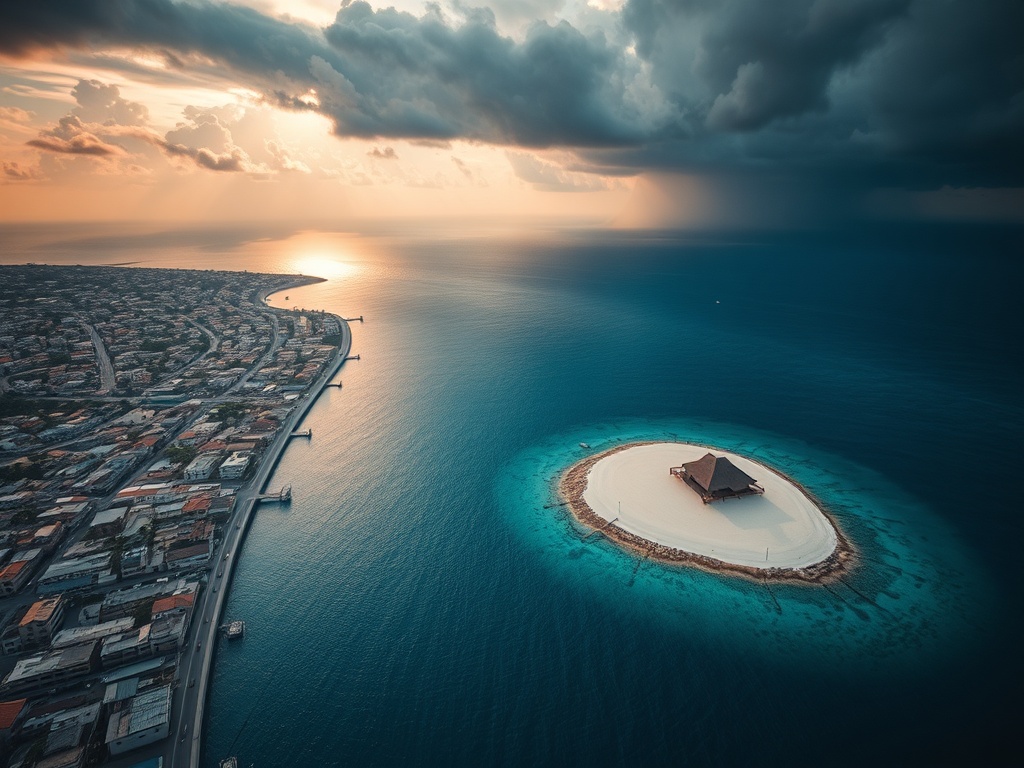
Where Malé's Towers Rise and Outer Atolls Wait
In the crowded archipelago nation where land is both precious commodity and political currency, housing policy has become the litmus test for governance. The recent electoral cycle revealed a fundamental truth: Maldivians will no longer tolerate policies that privilege the capital at the expense of the islands.
The Binveriya scheme, a flagship housing initiative, has become symbolic of a broader pattern of discrimination that voters rejected at the ballot box. What began as an attempt to address Malé's chronic congestion instead reinforced the perception of a system rigged in favor of the capital's residents. The policy generated more public outrage than any other initiative in recent memory, not merely for its implementation flaws but for what it represented—the perpetuation of a geographic hierarchy that has long defined Maldivian society.
This discontent reflects a deeper structural problem. When political parties centralize their housing vision around Malé, they ignore the reality that the housing crisis extends far beyond the capital's shores. In the outer atolls, families face their own challenges—from inadequate infrastructure to limited economic opportunities—yet find their concerns marginalized in national policy discussions.
The political consequences have been severe. The previous administration's defense of discriminatory housing policies proved electorally fatal, demonstrating that voters now judge parties by their commitment to equitable development across the archipelago. The lesson is clear: any party seeking national leadership must transcend the 'Male' supremacist' mindset that has long dominated political calculations.
What makes this moment particularly significant is how housing has become the proxy for larger questions of belonging and representation. For citizens of remote atolls, housing policy isn't merely about shelter—it's about whether the state sees them as equal stakeholders in the national project. When policies consistently favor the capital, they reinforce the perception that some Maldivians are more Maldivian than others.
The current political landscape suggests parties are struggling to adapt. Opposition movements appear weakened not just by internal divisions but by their failure to articulate a compelling alternative vision that addresses these geographic disparities. The challenge is particularly acute for established parties whose original members have achieved financial success and may have lost touch with the daily struggles of ordinary citizens across the islands.
As climate change threatens the very existence of these low-lying islands, the question of who gets to live where takes on existential dimensions. Housing policy today may determine which communities survive tomorrow. The political party that recognizes this—that understands housing as both a practical necessity and a moral imperative—will likely define the next chapter of Maldivian politics. Until then, the geography of discontent continues to shape a nation at a crossroads.
— Source fragments: Discriminative housing policy was one of the main reasons Ibu lost the last election; MDP centralized their housing voice for Male' not for the housing problem of the Maldives; The effects of this policy will be felt till Maldives goes under the waves; MDP's platform is riddled with double standards; All parties are scared of losing votes with supremacist attitude