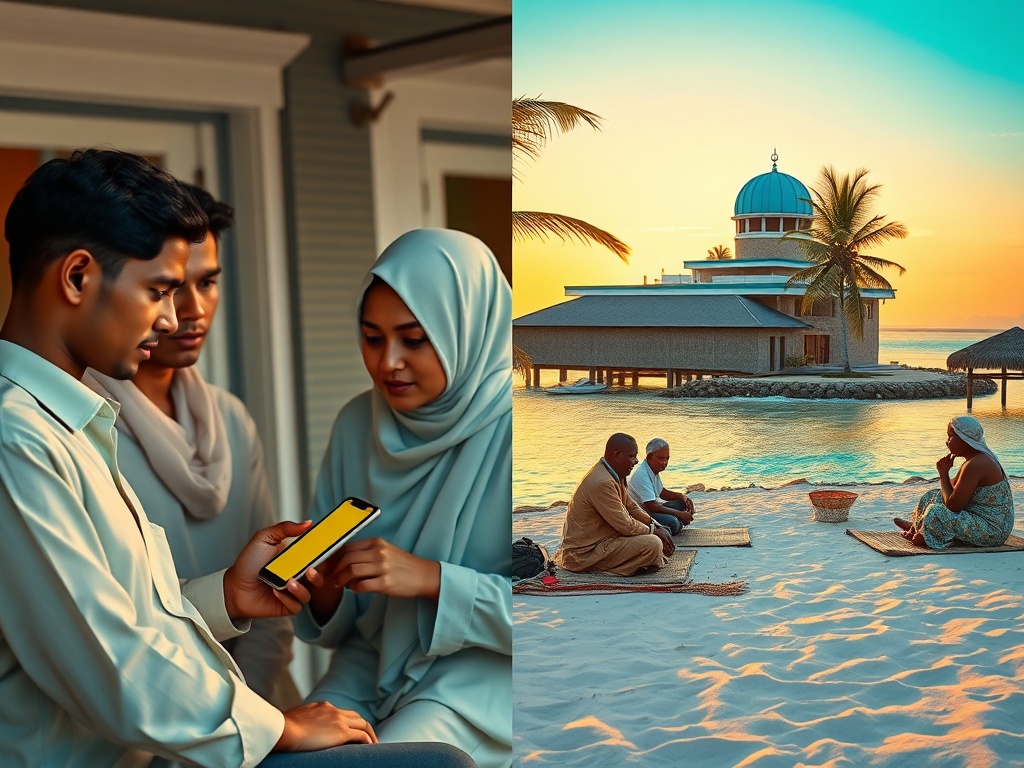
Where Political Voices Online Meet Silent Streets Offline
The digital squares of Maldivian politics buzz with conviction. Voices declare positions, demand accountability, and question allegiances. Yet beneath these declarations lies a persistent tension: the gap between online engagement and offline impact. As one observer notes, political parties understand this disconnect well—the vocal online crowd doesn't necessarily correlate with the critical mass that determines electoral outcomes.
This recognition forces a deeper examination of political identity in the Maldives. When someone questions whether tweeting about land distribution, universal basic income, and job guarantees qualifies them as socialist, they're touching upon a fundamental uncertainty in our political vocabulary. Our traditional left-right spectrum feels imported, ill-fitting. What does 'centrist' mean in a nation where basic needs—housing, healthcare, employment—remain unresolved for many?
The conversation inevitably turns to representation. With 76 lawmakers representing island communities versus 17 representing Malé, the geographical distribution of political power becomes a point of contention. Citizens increasingly demand their Members of Parliament advocate for their interests, texting them directly, expecting responsiveness. Yet this engagement often hits the wall of entrenched positions. As one voice acknowledges, certain issues will always divide the nation—we must accept this reality and seek other solutions.
This political landscape reveals a nation grappling with its identity. The question isn't merely who deserves what, but how we build systems that transcend personality-driven politics. When policy becomes personal, and persons become policy, the line blurs. Critics argue that condemnation should be consistent—calling out wrongdoing regardless of party affiliation—yet this principle often gets lost in partisan loyalty.
The Maldivian political experience reflects a broader global phenomenon, where digital engagement creates the illusion of influence while real power resides elsewhere. Like the American politician who 'kissed the cursed wall and lost,' our political actors navigate symbolic gestures and substantive action. The challenge becomes finding pathways that bridge the digital and physical, the symbolic and material.
Perhaps the solution lies not in declaring positions but in examining what actually improves lives across our scattered islands. When housing remains unaffordable, healthcare inadequate, and opportunities limited, ideological labels matter less than tangible progress. The true political center might be found not in moderate positions between extremes, but in practical solutions that address our most pressing shared challenges.
— Source fragments: Good that you realized you have crossed the line between policy and persons; Anyone up for a protest Or do we have RT MPs on our side to advocate; I am sure we have 76 lawmakers representing islanders to 17 Male' Law makers; They are counting on the off line critical mass. The online crowd is vocal online. it doesn't correlate with offline reality; Maldivian socialist ey? Who are they; i am CENTRIST; I don't call myself a socialist but I have been tweeting about giving away land, giving ubi, giving job as a right; It's an issue where the country will always be divided on. We have to accept that fact. Find other solutions