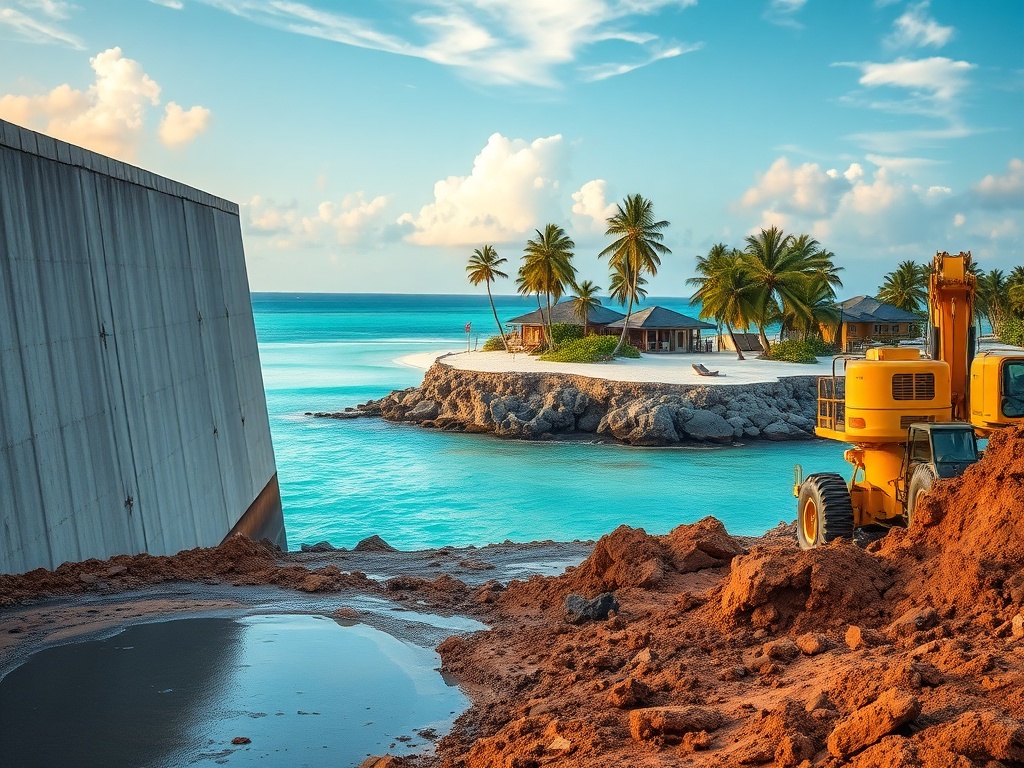
Where the Sand Meets the Concrete Wall
Across the newly reclaimed islands of the Maldives, an unsettling transformation is underway—the gradual disappearance of usable beaches. What began as ambitious development projects to alleviate overcrowding and create new land has revealed an unintended consequence: the erosion of the very natural features that define island life.
The issue is particularly acute in high-tourism zones, where already limited sandy coastlines are being further compromised by reclamation works. These beaches represent more than just recreational space—they are ecological buffers, cultural touchstones, and economic assets. Their disappearance threatens the delicate balance that has sustained Maldivian communities for generations.
This environmental concern is rapidly evolving into a social movement. The suggestion of citizens chaining themselves to trees—not as political protest but as environmental defense—signals a shifting public consciousness. The imagery is powerful: ordinary Maldivians physically protecting what remains of their natural heritage against the machinery of progress.
Meanwhile, the conversation around solutions reveals deeper systemic challenges. The push for electric vehicles, while environmentally conscious, highlights infrastructure gaps—charging stations powered by fossil fuels undermine the ecological benefits. More fundamentally, traffic congestion persists, suggesting that technological fixes alone cannot solve problems rooted in planning and scale.
At the heart of the debate lies a critical governance gap: the absence of clear legal frameworks for environmental stewardship. As one observer noted, we lack consistent criteria for determining the fate of ancient trees and natural features, leaving decisions vulnerable to shifting political winds and personal preferences. These living monuments to our history deserve protection based on objective standards, not endless debate.
The beach erosion crisis encapsulates broader tensions in Maldivian development—between immediate economic needs and long-term sustainability, between centralized planning and local knowledge, between the promise of progress and the preservation of identity. As the shoreline recedes, so too does our connection to the environmental wisdom that has guided island life for centuries.
What emerges from these conversations is not merely a complaint about disappearing sand, but a growing demand for thoughtful development—one that recognizes that in an island nation, environmental preservation isn't a luxury but a necessity for survival. The challenge ahead lies in building not just new land, but new frameworks for coexisting with the fragile ecosystems that make the Maldives unique.
— Source fragments: A significant problem is emerging on several newly reclaimed islands: the absence of usable beaches; There seem to be at least 100 of you that are mad about it. If all 100 collectively chained themselves to the tree; Not when we are using fossil fuel again to charge EV vehicles. Also that wont solve the congestion issue aswell; What we lack in the Maldives is a clear guideline or law that allows us to decide the fate of ancient trees based on consistent criteria