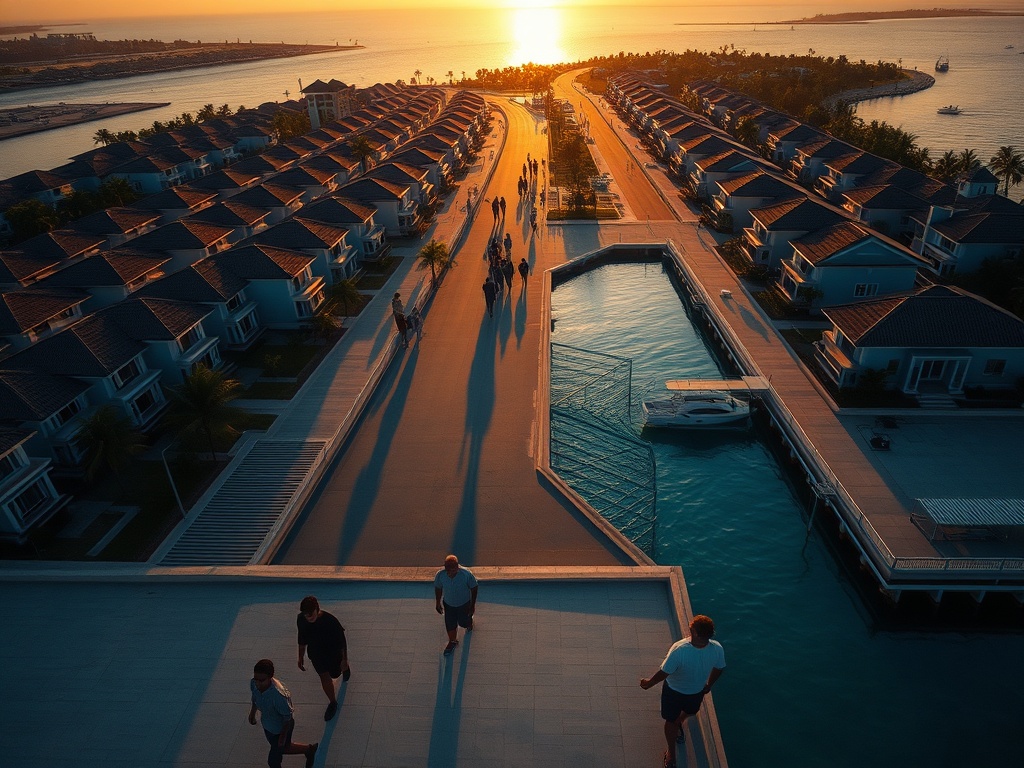
Who Gets a Hulhumalé Flat and Who Gets Left Behind
In the relentless push and pull of Maldivian politics, land distribution programs have consistently emerged as both promise and punishment. The debate surrounding who qualifies for housing in Hulhumalé and similar developments reveals a fundamental tension in our national identity—between the rights of long-standing Malé residents and the growing population of registered temporary residents who have made the capital their permanent home.
The Veshifahi and Binveriya schemes, while framed as solutions to the capital's chronic housing shortage, have become lightning rods for accusations of systemic discrimination. Critics argue these programs perpetuate a narrow definition of belonging that excludes those who migrated to Malé from outer islands, despite having lived and worked in the capital for years, even decades.
The constitutional guarantee of equal rights rings hollow when housing policies create a two-tier system of citizenship. Registered temporary residents, who migrate to Malé for education, employment, healthcare, and opportunity—the very drivers of national development—find themselves perpetually temporary in the eyes of housing policy. They contribute to the economy, pay taxes, and send their children to schools, yet remain excluded from the most fundamental aspect of settlement: secure housing.
This isn't merely about allocation of physical space. It's about the soul of our capital city. Malé didn't develop through some innate genius of its native population, but through the collective labor, innovation, and ambition of people from across the archipelago. The nurse from Huvadhoo, the teacher from Addu, the construction worker from Noonu—these are the people who built modern Malé alongside those born within its confines.
The current administration faces the same test as its predecessors: whether to use housing policy as a political tool to reward supporters or as a mechanism for building a more inclusive capital. The constitutional mandate is clear—all residents must enjoy equal rights and opportunities. Yet implementation remains mired in political calculation.
As land reclamation creates new territory literally from the sea, we must ask what kind of society we're building on this newly formed ground. Will it be one that recognizes the contributions of all who call Malé home, regardless of their island of origin? Or will we continue to draw artificial lines in the sand—or rather, in the concrete—that divide Maldivians into categories of more or less deserving?
The solution requires moving beyond political expediency toward a principle-based approach to urban development. Housing schemes should reflect the reality of Malé as a national capital, not a tribal stronghold. The right to secure housing shouldn't depend on how many generations your family has lived within these few square kilometers, but on your contribution to the community and your need for a place to call home.
In the end, the measure of our development won't be the number of towers we build, but the breadth of community we create within them.
— Source fragments: Hulhumalé as land for Malé people only, discrimination with Binveriya scheme, registered temporary residents shouldn't be excluded, equal opportunity to apply, constitutional rights, Malé development not due to purebred genius