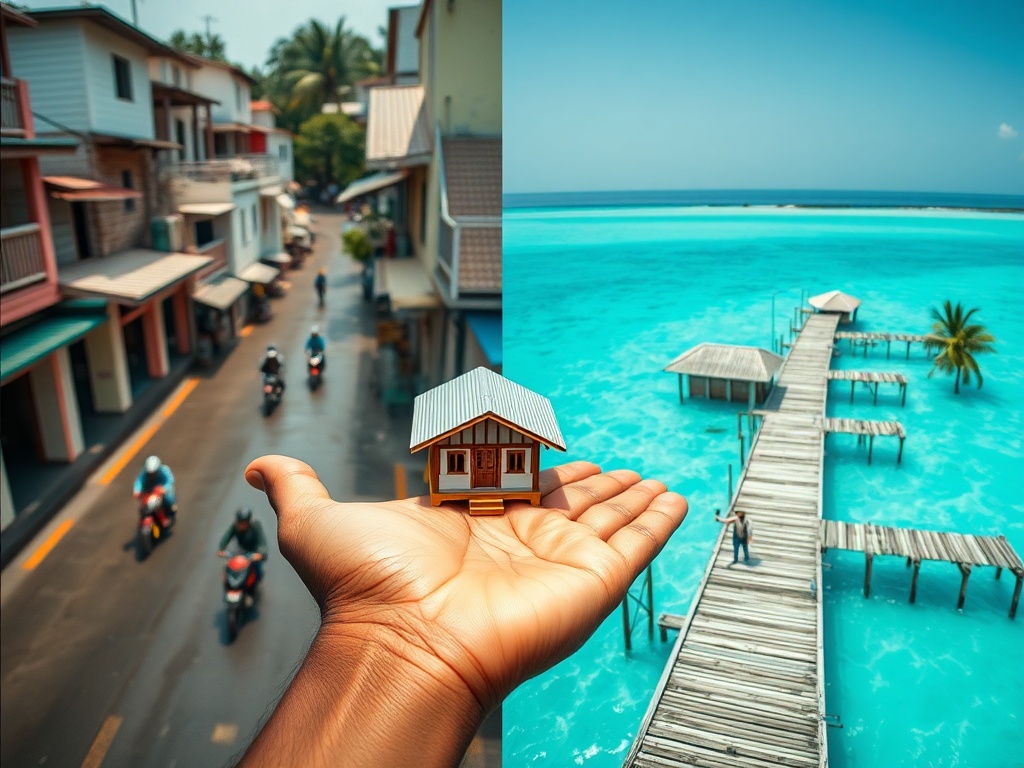
Who Gets the House When Two Maldivians Claim One Plot?
The conversation begins with land, but quickly spirals into something deeper—a national reckoning with identity, history, and who gets to call which part of the Maldives home. At the heart of the debate is a simple, painful question: why are some citizens deemed more deserving than others when it comes to the most basic of resources?
In recent weeks, social media has become a battleground for competing narratives. One side argues that Malé, as the nation’s capital, was built using national funds and should serve the collective interest—not just those born within its ever-expanding boundaries. The other insists that Malé residents, too, deserve dignified housing, but warns against what they describe as “Malé supremacy”—a systemic bias that prioritizes the capital at the expense of the atolls.
This is not merely a policy disagreement. It is a reflection of generational and geographic divides that have long simmered beneath the surface. Many young people from the islands speak of a double bind: no opportunity in the islands because they moved to Malé, and no opportunity in Malé because they were born elsewhere. They call themselves the “baakee generation”—left behind, caught between worlds.
The language of discrimination is stark. Some point to the term “raajjetherey,” used to describe those from the atolls, as carrying a subtle but persistent stigma. Others reject the framing altogether, arguing that the real issue is not regional identity but fairness. If the state provides land, they contend, it must do so without prejudice—a principle they feel has been violated by recent policies.
What emerges from these fragments is a portrait of a society grappling with the legacy of centralization. For decades, Malé has absorbed the nation’s resources, talent, and ambition. Wealthy landowners in the capital often trace their roots to the atolls, yet their descendants now hold disproportionate power. The result is a system where geography can determine destiny.
This is not just about land. It is about memory. It is about the quiet humiliations of renting from a Malé landlord while being called an outsider in your own country. It is about watching new reclamation projects extend the capital’s reach while outer atolls wait for basic infrastructure. It is about the fear that the next generation will not be as patient as the last.
The government’s role in this dynamic cannot be overlooked. Past and present administrations have used housing and land distribution as political tools, creating a patchwork of entitlements that often reinforce existing inequalities. The result is a public conversation fractured by mistrust, where every allocation feels like a verdict on belonging.
There are no easy answers. But one thing is clear: the issue will not be resolved by dismissing lived experience or reducing complex grievances to simplistic labels. It requires a national dialogue—one that acknowledges the pain on all sides and seeks a future where every Maldivian, regardless of origin, has a place to call home.
— Source fragments: Malé people don’t deserve free land; Malé supremacy will ruin rest of Maldives; raajjetherey trauma; baakee generation with no opportunity; discrimination in land distribution; Malé landlords; inequitable distribution of wealth; historical grievances between capital and atolls.