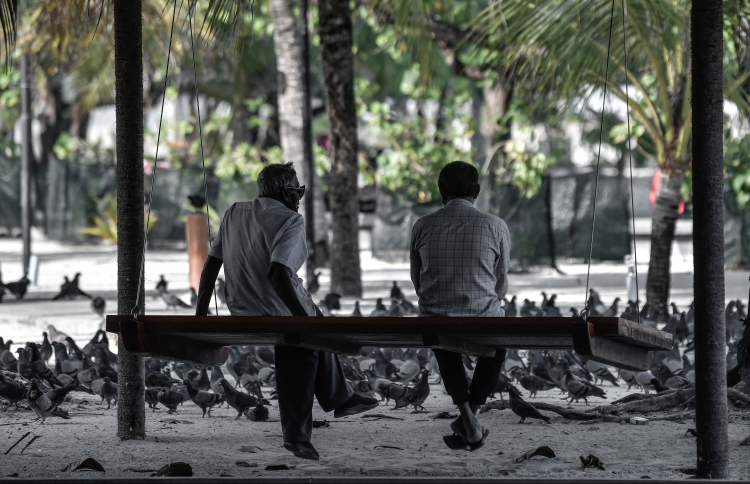
World Bank Warns Maldives Faces Race Against Time as Population Ages Fastest in the World
The World Bank has warned that the Maldives is one of the countries whose population is ageing at the fastest rate in the world, and that unless major economic and social reforms are brought before 2044, the narrow opportunity to become a wealthy country could be lost.
According to the "Demographic Change in South Asia: From Tailwinds to Headwinds for Development" report released by the World Bank this month, unlike other countries in South Asia, the Maldives alone has the potential to become a wealthy country before its population ages. However, due to the speed at which the population is ageing, the Maldives faces a strong race against time.
According to the report's statistics, in an average South Asian country, it will take 25 years for the population to shift from a growing population to an ageing population. In other developing countries, this takes an average of 32 years, while in developed countries it has taken 46 years. But in the Maldives, this change will come in just 13 years.
Seven percent of the Maldives' population are people over 65 years of age, and it will change to the status of an "ageing population." The proportion of the working-age population (15-64 years) will reach its highest point, and after that the proportion of working people will begin to decline. Fourteen percent of the population will be people over 65 years of age, and the Maldives will change into a country with an "ageing population," and by 2050 this proportion will rise above 20 percent.
The opportunity to become wealthy before the population ages exists in this region only for the Maldives, the World Bank said. It is an opportunity that no other country in the region has, but it has been said that the opportunity available to achieve this is narrow.
The Maldives' per capita income is already higher than that of other countries in the region. If the economic growth rate of 2013 to 2023 is maintained, it is estimated that when the Maldives becomes an ageing population in 2044, per capita income will rise above 25,000 dollars.
This is significant progress when compared with other countries in the region. When the populations of countries such as India, Bangladesh and Nepal age, their per capita income will be even lower than the level that other developing countries had when they began to age. And Sri Lanka, which will become an ageing population in 2030, is in the midst of a major financial crisis.
However, as the World Bank noted, there are dangers that could cause this opportunity the Maldives has to be lost. Especially at this time when state expenditure has grown large, the expenditure that will need to be made on health services and social protection due to population ageing will increase extremely.
According to the report, the main areas in which the Maldives needs to take urgent steps before 2044 are:
While the average life expectancy of a child born in the Maldives is approaching 80 years, only about 70 years are spent in full health. It is important to establish a primary health care system that reduces reliance on hospitals and detects non-communicable diseases early, and to produce trained people who will care for the elderly.
Since the working-age population will begin to decline after 2033, barriers to women entering employment must be removed, and the path must be paved for older people also to learn new skills and be able to remain in work for more days.
While ordinary jobs available to the region's youth have fallen by 24 percent due to artificial intelligence, financial assistance must be expanded to teach youth the modern skills they need and to develop their own businesses.
As the population of older people grows in the future, rapid steps must be taken to maintain the pension system sustainably and to increase state revenue and reduce expenditure.