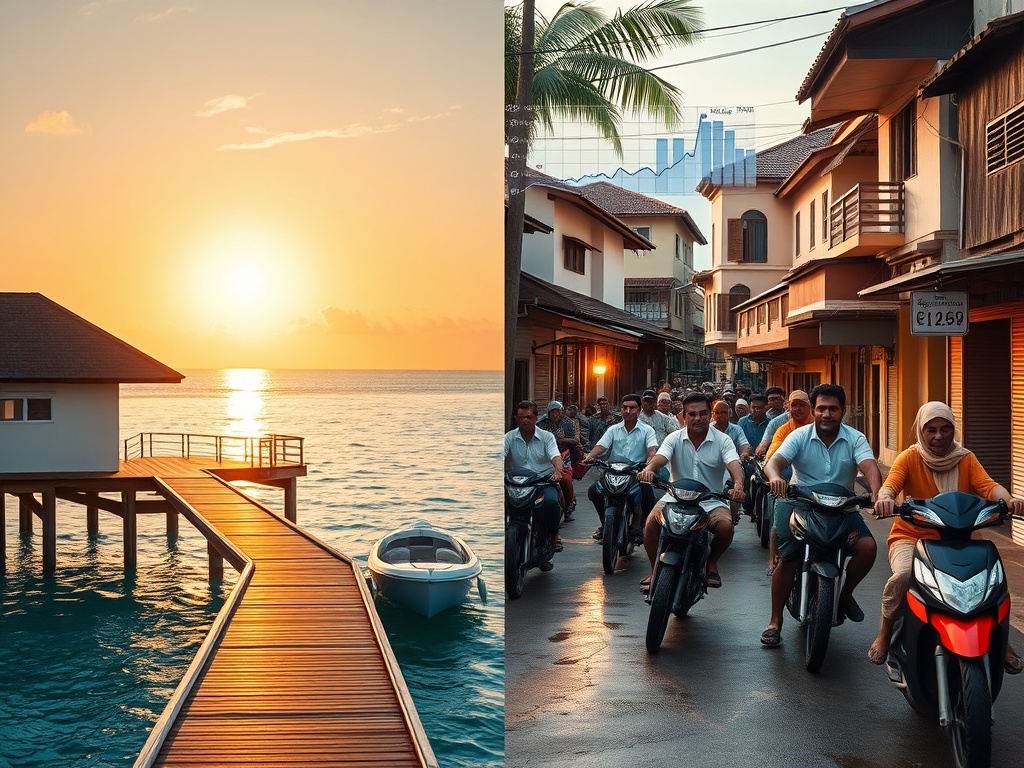
World Bank's 3.9% Growth Forecast Meets Male's Crowded Streets
The World Bank's projection of 3.9% GDP growth for 2026 hangs over the Maldives like an economic verdict—a figure that would represent the slowest expansion in recent memory. This forecast arrives amid a perfect storm of policy contradictions: remittance caps that strain the Indian diaspora, forced USD forex policies degrading the Rufiyaa, and a national banking system struggling with liquidity constraints.
The debate reveals deeper structural tensions. While tourism generates approximately 80% of national revenue, critics question whether resort owners truly leverage their position for national benefit or primarily for private gain. The industry's pioneers, predominantly from Male', transformed the economy but also contributed to the decline of other potential sectors like shipping, which some argue could have rivaled tourism's economic impact.
This economic concentration creates what observers describe as an inequitable wealth distribution favoring a privileged few. The pattern repeats: prime real estate development, housing policies, and banking limitations mean only the wealthiest families can access opportunities without relying on loans. Meanwhile, forced economic migration continues to swell the Male' region, creating social pressures that reflect deeper economic dislocations.
Policy contradictions abound. Initiatives that might benefit the economy in theory—like certain development projects—often fail in practice due to implementation challenges and the country's fragile financial position. With billions in external and internal loans, over 50,000 people needing immediate housing, and healthcare systems overloaded, the fiscal space for ambitious projects remains constrained.
The fundamental question facing policymakers is whether the current economic model can evolve beyond its tourism dependency. Fifty-three years after tourism's introduction, the promised economic revolution remains incomplete. The service sector dominance provides relative wealth compared to agricultural-dependent neighbors, yet the benefits remain unevenly distributed.
What emerges is a picture of an economy at a crossroads—caught between its tourism success story and the need for broader economic diversification, between immediate political pressures and long-term structural reforms. The solutions will require addressing not just economic indicators but the underlying governance and distribution challenges that have persisted across administrations.
— Source fragments: World Bank forecasts 3.9% GDP growth for 2026; Cap on remittance leaves Indian diaspora in Maldives in the lurch; do the resorts really have leverage though; national banking system tgst forced usd forex policy; Inequitable wealth distribution in favor of a privileged few; tourism industry generates 80% of national revenue; They also played a pivotal role in destroying the shipping industry; majority of people are in Male' region by forced economic migration; country is nearly bankrupt & this is v irresponsible; Only the wealthiest families will be in a position to develop the land