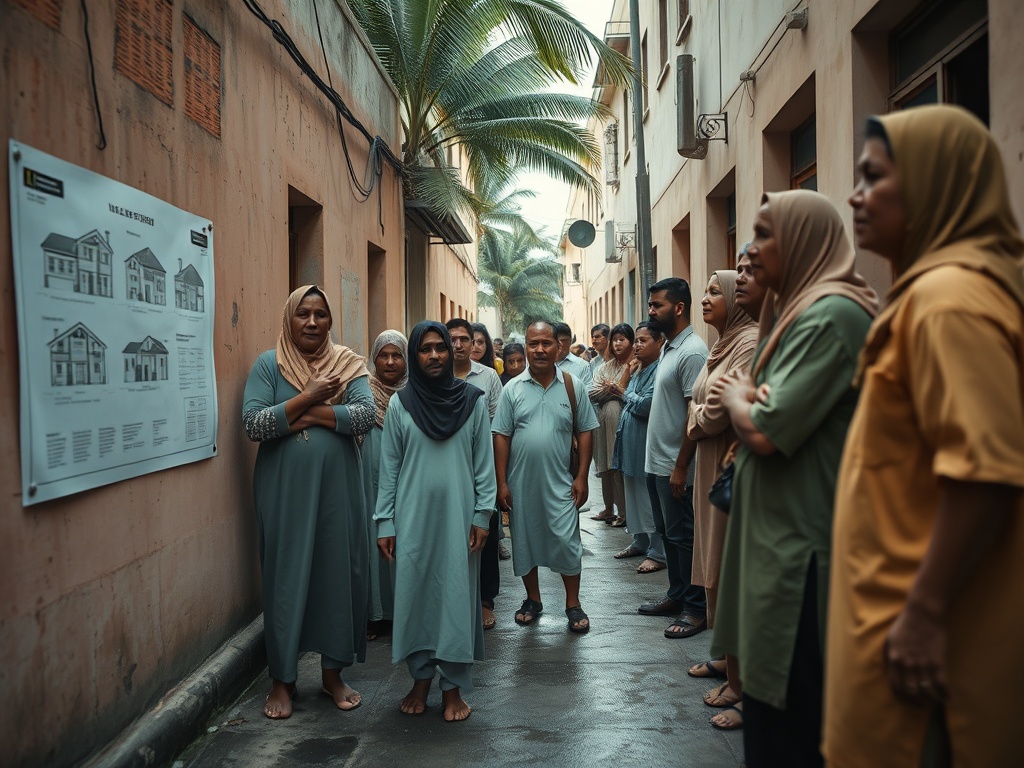
Young Activists Confront 'Senile Old Men' Over Housing
In the heated corridors of Maldivian politics, a quiet revolution is brewing—one that pits youthful idealism against established party machinery. The recent emergence of young activists challenging what they describe as "senile old men" running political parties signals a generational shift in how Maldivians engage with power. Yet this challenge reveals deeper contradictions within the opposition movement itself.
The controversy centers on housing policy, specifically the Binveriya Scheme that has become a lightning rod for accusations of discrimination. Critics argue the program favors certain constituencies while neglecting broader constitutional obligations. The scheme has exposed political fault lines, with some politicians appearing to shift positions dramatically—from vocal opposition to quiet acceptance once political favors were exchanged. This pattern of sudden ideological flexibility has left many supporters disillusioned.
The debate extends beyond housing to fundamental questions about political representation. Does loyalty to one's Male constituency justify abandoning broader national responsibilities? Can a party that champions decentralization remain silent when atoll councils face dissolution? These questions strike at the heart of what opposition politics should represent in the Maldives.
Meanwhile, the political theater continues with stark contrasts: one figure summoned via Interpol while another receives awards, creating a perception of selective justice that further erodes public trust. The situation reflects a broader pattern in Maldivian politics where accountability appears unevenly applied, and political survival often trumps principle.
At the core of this turmoil lies the struggle for the Maldivian Democratic Party's soul. As the party prepares for upcoming leadership contests, questions about fitness for chairpersonship revolve around more than just political skill—they touch on integrity, consistency, and the ability to represent a new generation demanding transparency. The criticism that some politicians only speak when the audience applauds suggests a performative aspect to politics that increasingly alienates citizens seeking substantive debate.
The housing crisis in Male, with its overcrowded conditions and politicized allocation systems, serves as a microcosm of these broader political failures. When subsidized flats become political currency rather than solutions to genuine need, the social contract frays. The accusation that some beneficiaries sublease these properties for profit while living abroad underscores how well-intentioned programs can be corrupted by the very systems meant to administer them.
What emerges is a portrait of a political landscape at a crossroads, where traditional loyalties are being tested against emerging ethical standards. The children of the revolution now question whether the parties they helped build have become the very establishments they sought to overthrow. As one observer noted regarding the Binveriya Scheme, the true test of political leadership isn't just what one opposes, but what principles one upholds when political winds shift.
— Source fragments: They been trying to.find a way to drag his name through the mud ever since he and a few young individuals baded together against the senile old men who run a party; He supports the discriminatory Binveriya Scheme; He couldn't fulfill his Constitutional duty to the public, but he did to his Malé constituency; why don't you speak against the dissolution of atoll councils; He is someone who only speaks when audience claps; He was very LOUD about racist housing scheme up until Ibu bought him toys; One has been summoned via interpol while the other is being given awards