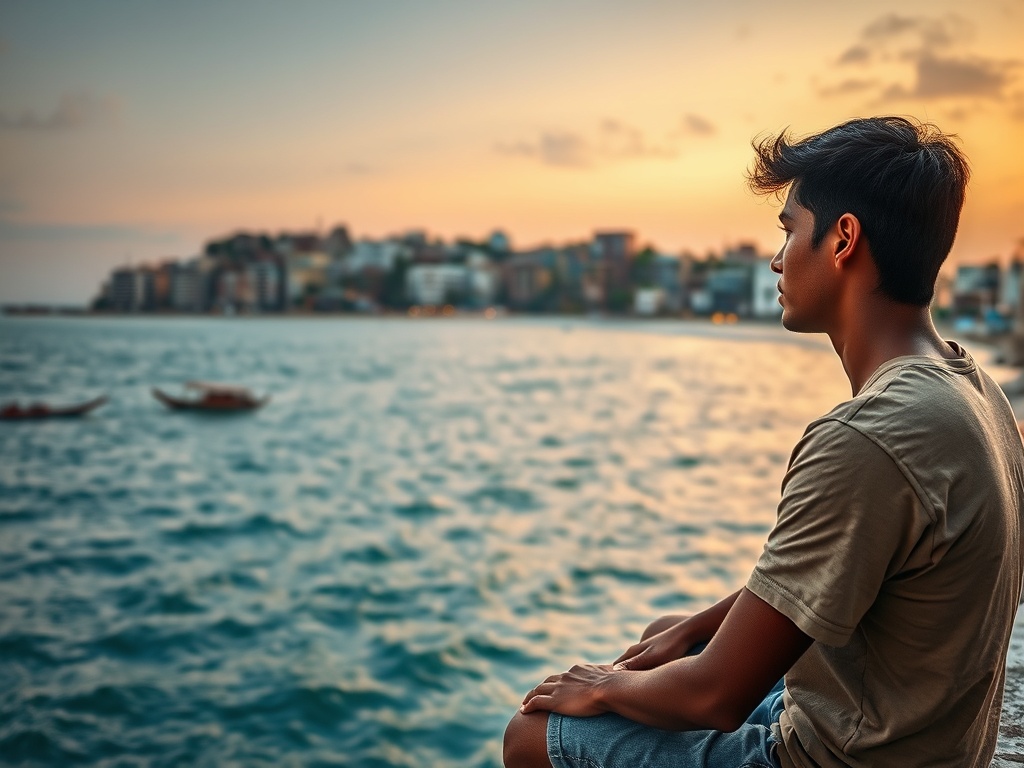
Young Men at the Harbor Watching Boats Return Without Them
The sea teaches patience in its endless rhythm, but on these islands, patience has become a cage. You can see it in the eyes of young men lingering at the harbor as fishing boats return without them, in the careful calculations of women scrolling through job listings that never refresh. There's a particular heaviness to waiting when you're surrounded by so much blue expanse—the irony of being trapped on islands while dreaming of horizons.
At the tea shop near the harbor, conversations drift like monsoon clouds—sometimes hopeful, often heavy. Young men speak of applications sent to resorts, of certificates earned that somehow don't translate to work. Their education floats between worlds, not quite fitting the tourism economy that sustains us, yet too advanced for the traditional livelihoods their fathers knew. The sea that once provided now feels like a moat separating them from something just beyond reach.
In cramped apartments where families stack like fishing nets, the mathematics of survival gets recalculated daily. The price of onions, the cost of schoolbooks, the relentless climb of numbers that never quite match the figures in bank accounts. You learn to measure life in different currencies—not just rufiyaa, but in borrowed time, in favors called, in the quiet sacrifice of mothers who serve smaller portions so their children might have more.
The real crisis isn't just in the crowded hospitals or the classrooms with too many students. It's in the space between expectation and reality, where dreams go to wait. The government buildings with their grand promises stand as monuments to what could be, while the youth float in this liminal space—educated enough to want more, yet bound to islands that cannot contain their aspirations.
Sometimes, sitting on the seawall as dusk paints the lagoon gold, you can almost feel the collective sigh of a generation holding its breath. The tide continues its faithful coming and going, but for those caught between the practical and the possible, between the islands they call home and the futures they imagine, the waiting has become its own kind of weather—constant, enveloping, with no forecast for change.
— Source fragments: Youth issues: Drug use, unemployment, lack of educational/job opportunities; Housing: Crisis in congested capital, Malé; Economy: High cost of living; Society: Youth issues