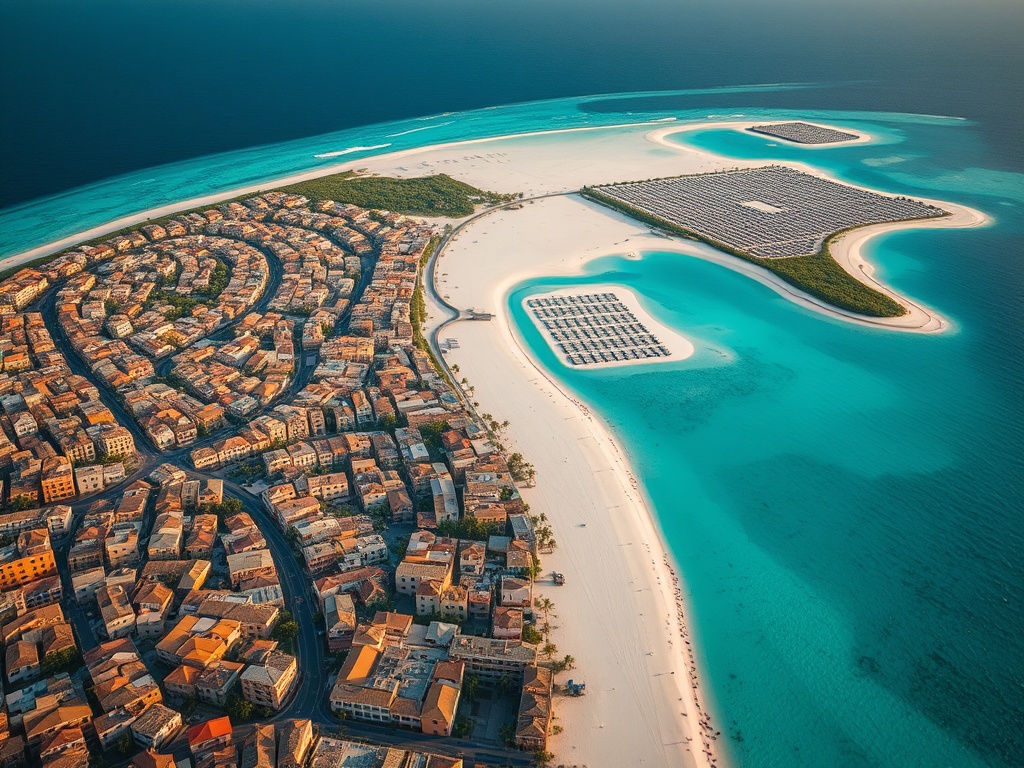
Your Island of Birth Determines Your Future Land Rights
The debate over land in the Maldives has become one of the defining conversations of our generation, exposing deep structural inequalities that bind citizens to their islands of birth while concentrating wealth in the hands of a few. The current system functions like a modern feudal arrangement, where geographic origin determines opportunity and mobility remains a privilege rather than a right.
Consider the paradox: while population growth stagnates across many islands, land scarcity persists as an artificial crisis. The problem isn't the physical availability of land—multiple reclamation projects from Dhidhoo to Addu have created vast tracts of vacant property—but rather how it's distributed and held. Wealthy individuals accumulate thousands of square feet through inheritance and political connections, while ordinary citizens struggle to secure even a modest plot to call their own.
The Binveriya scheme has become emblematic of these systemic failures. While intended to address housing needs, its implementation has reinforced existing disparities. The requirement to surrender inherited property in Malé to qualify for land grants elsewhere creates impossible choices for those with deep family roots in the capital. Meanwhile, the policy exempts powerful landowners who hold vast unused properties across multiple atolls.
This isn't merely about housing—it's about economic freedom. The ability to move for employment, to build equity through property ownership, to participate fully in the national economy should not be determined by birthplace. When a skilled professional from the north receives a job offer in Addu, they should be able to buy property, build a life, and eventually sell that asset without facing bureaucratic barriers that treat inter-atoll mobility as exceptional rather than normal.
Policy solutions exist but require political courage. Implementing land taxes that make hoarding unproductive property economically burdensome would encourage circulation of unused land. Creating transparent land registries and standardized valuation systems would democratize access. Most importantly, we need to separate the concept of land as political patronage from land as a fundamental right of citizenship.
The conversation has shifted from whether land distribution is broken to how we build a system that serves all Maldivians, not just those born in certain postcodes or with certain connections. The solution lies not in more reclamation projects or temporary schemes, but in reimagining land ownership as a tool for national development rather than political consolidation.
— Source fragments: currently we are stuck with land we are born in, feudal system, population dying so enough land always, land hogging by wealthy people, Binveriya scheme requirements, inherited property dilemmas, vacant reclaimed lands, policy solutions for equitable distribution