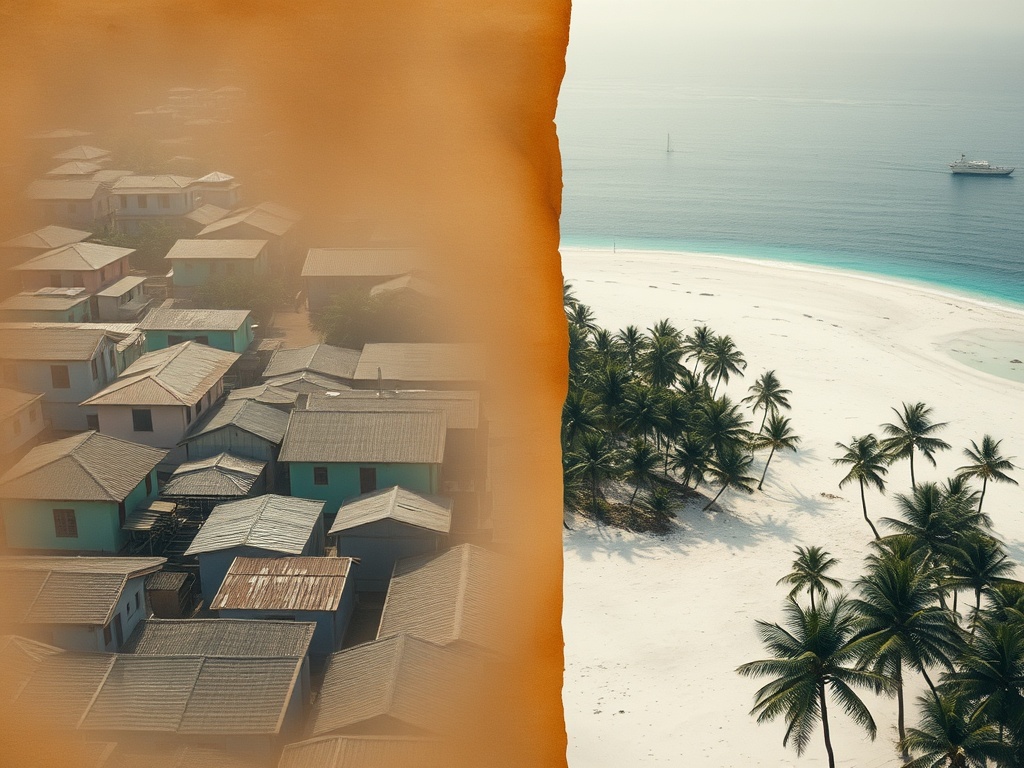
Your Job Offer in Addu, Your Family’s Land in Malé
We are still tethered to the land where we were born—a system that feels feudal in its rigidity. This isn't merely about geography; it's about opportunity, mobility, and the fundamental right to choose where to build a life. Imagine receiving a promising job offer in Addu while your family roots lie in the northern atolls. In a functional system, you could buy property, settle for your employment tenure, then sell and return north when circumstances change. This basic economic mobility remains elusive for many Maldivians.
The population isn't growing—it's declining in many islands. There should theoretically be enough land for everyone, yet the distribution remains profoundly unequal. Land represents wealth, and those who possess it rarely advocate for systems that might redistribute it. The conversation about land reform often finds its most passionate voices among those who have the least to lose from the status quo—precisely those who would benefit most from change.
The core issue isn't scarcity but utilization. Vast tracts lie dormant while families cram into Malé's congested neighborhoods. When prominent businessmen hold extensive unused properties, the system shows its flaws. Policy could address this by making land retention costly, encouraging productive use rather than speculative holding.
Consider the reality for many: inheriting nominal plots that may be unusable or insufficient while paying rent in Malé for decades. Meanwhile, others receive land simply for having Malé ancestry, creating generational advantages that compound over time.
The Binveriya scheme represents one of our generation's most significant challenges—not merely in its implementation but in what it reveals about our approach to land, equity, and political calculation. When people must surrender existing rights to qualify for new allocations, the system creates impossible choices. When conversion costs prove prohibitive, many simply abandon their claims.
Previous reclamation projects in Dhidhoo, KF, Hinnavaru, Naifaru, and Addu created new land that often remains underutilized. The solution isn't necessarily more reclamation but better utilization of what already exists.
What's given cannot easily be taken back, but we can build smarter systems moving forward. The debate continues because not everyone agrees on fundamental principles—some see land as entitlement, others as investment, and many as basic necessity. Until we confront these divergent perspectives directly, we'll continue applying patchwork solutions to systemic problems.
The way forward requires moving beyond political point-scoring to address the underlying architecture of land ownership. We need policies that recognize both the practical needs of citizens and the economic realities of development. This means creating mechanisms for affordable land access while discouraging speculation, supporting inter-atoll mobility while preserving cultural connections, and above all, treating land not as political currency but as foundation for national progress.
— Source fragments: currently we are stuck with land we are born in; feudal system; population is not growing; land hogging; inherited land; Binveriya scheme; land reclamation projects remain vacant; policy solutions